
FAA Examiner Talks about FAA Grounding of all Aircraft
Via NewsNation:
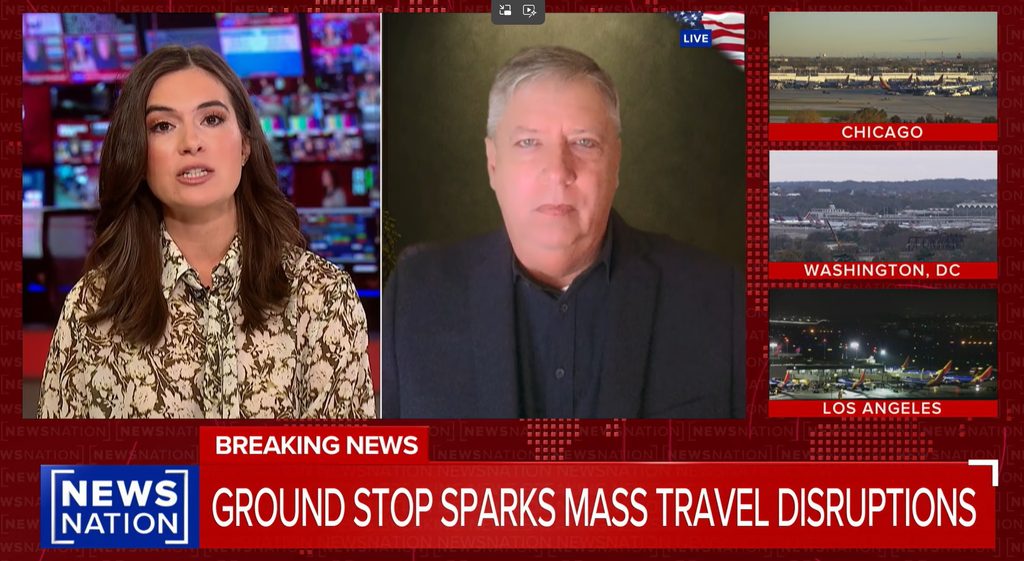
The Federal Aviation Administration’s (FAA) unprecedented decision to ground flights nationwide has raised serious questions about the reliability, security and preparedness of America’s air traffic control infrastructure. During an interview with NewsNation, Mark Harris, a decorated former Air Force Special Operations pilot, FAA examiner and aviation expert, examined the circumstances surrounding the massive disruption, the potential implications for passenger safety and the vulnerabilities exposed by an incident that brought commercial air travel across the United States to a virtual standstill.
On Friday, November 13, the FAA issued a nationwide ground stop after experiencing a telecommunications failure that affected critical systems used by air traffic controllers to communicate with aircraft and coordinate air traffic. The disruption forced the agency to halt departures across the country while controllers worked to manage aircraft already airborne and ensure their safe arrival. The ground stop lasted approximately four and a half hours, but its consequences extended well beyond the initial shutdown, creating a cascading disruption throughout the nation’s aviation network.
Approximately 3,500 aircraft were in the air when the ground stop was implemented. Although aircraft already airborne were permitted to continue to their destinations, the inability to maintain normal departure operations created significant complications for airlines, airports, passengers and flight crews. Thousands of travelers were stranded, flights were canceled or diverted, and the resulting backlog continued to affect airline schedules even after the FAA lifted its restrictions. The agency subsequently reported more than 12,000 cancellations on Friday alone, with additional disruptions continuing into the weekend.
Harris brings a particularly valuable perspective to the discussion because of his extensive experience in aviation, military operations and aircraft safety. As a former Air Force Special Operations pilot who served in a combat zone, he understands the importance of reliable communications, coordinated operations and redundant systems in environments where even seemingly minor technical problems can have significant consequences. His background in physics and aeronautical engineering, combined with his work training corporate pilots and serving as an FAA examiner, provides him with a broad understanding of the technical and operational demands of modern aviation.
One of the central issues surrounding the grounding is the condition of the nation’s aging air traffic control infrastructure. The FAA has acknowledged that legacy telecommunications equipment experienced instability after an unusually high volume of data flooded portions of its network. Preliminary findings have focused attention on equipment and maintenance work involving L3Harris, the contractor responsible for elements of the FAA’s telecommunications infrastructure. Investigators are examining whether router replacement work at a remote facility contributed to the disruption and how a problem involving equipment in one location could affect communications across such a substantial portion of the national airspace system.
The incident also highlights the importance of redundancy in aviation safety. Modern commercial aviation depends on multiple interconnected systems, including radar, radio communications, flight tracking, navigation and coordination between air traffic control facilities. These systems must function together to ensure aircraft can safely navigate crowded airspace. When one component becomes unstable, the ability of other systems to compensate becomes critical. The nationwide ground stop raises important questions about whether existing backup capabilities are sufficient to protect the aviation system against widespread technical failures.
Another issue receiving attention is whether the disruption could have involved a cyberattack or some other form of external interference. Federal officials have stated that investigators have found no evidence of malicious activity, although determining precisely what happened remains an ongoing process. Harris’s aviation and technical background makes him well positioned to explain the distinction between a telecommunications failure, an equipment malfunction, a network vulnerability and an intentional attack. Understanding those differences is essential when evaluating both the immediate incident and the broader security of the nation’s aviation infrastructure.
The timing of the incident has also intensified scrutiny of the FAA’s modernization efforts. Federal officials have repeatedly acknowledged the need to replace outdated technology and strengthen the systems responsible for managing American air traffic. However, modernization itself introduces operational challenges, particularly when new equipment must be integrated into infrastructure that remains essential to daily operations. The incident raises questions about maintenance procedures, contractor oversight, testing protocols and the safeguards necessary to prevent improvements from inadvertently disrupting existing systems.
For Harris, the broader significance extends beyond delayed flights and frustrated passengers. The United States operates one of the world’s busiest and most complex aviation networks, and its continued reliability is essential to commerce, national security, emergency response and everyday transportation. A disruption capable of grounding aircraft nationwide demonstrates how dependent the country has become on interconnected technological infrastructure.
The interview provides an opportunity to examine what happened, why the failure had such widespread consequences and what must change to prevent a similar incident from happening again. It also underscores the importance of having aviation professionals who understand both the technical systems behind modern air travel and the practical realities of keeping aircraft, passengers and crews safe.
Ultimately, the nationwide grounding serves as a warning that America’s aviation infrastructure cannot be taken for granted. Restoring normal flight schedules is only the immediate challenge. Ensuring that the underlying systems are dependable, resilient and capable of meeting the demands of modern air travel is the much larger responsibility.