
Via Fox News:
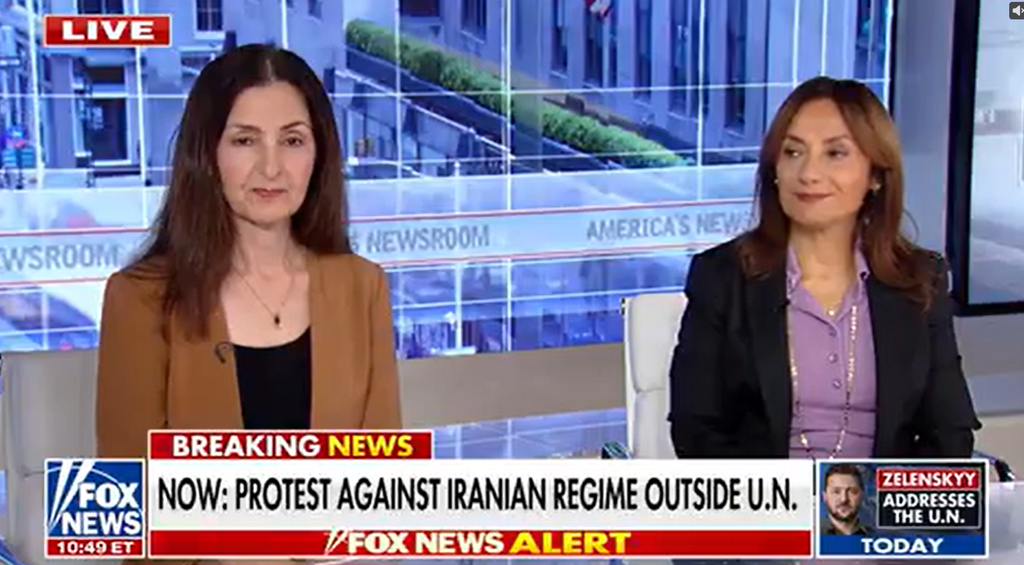
Former Iranian political prisoners Homeira Hesami and Shirin Nariman appeared in-studio on Fox News’ America’s Newsroom to discuss their experiences under Iran’s clerical regime and the anti-regime demonstration they attended in New York City during the United Nations General Assembly. The September 23 interview came as Iranian President Masoud Pezeshkian and other Iranian officials were in New York for the annual U.N. gathering, putting the Iranian government and its opponents in the same city and drawing increased attention to the country’s political and human-rights record.
Both women brought firsthand experience to the discussion. Nariman has publicly described being imprisoned in Iran at age 17 and spending approximately two years as a political prisoner. In previous testimony, she recalled witnessing the torture and execution of fellow prisoners, including friends she knew personally. She has also spoken about the 1988 mass executions of political prisoners and the lasting impact those events had on survivors and families. Hesami has likewise described being imprisoned as a teenager for political activism and criticism of Iran’s clerical government. Her history of political activism continued after leaving Iran, including decades of advocacy for Iranian democracy in the United States.
Their appearance focused heavily on the contrast between the Iranian government’s presence at the United Nations and the voices of Iranians who oppose the regime. The women were in New York for a rally across from the United Nations, where Iranian opposition supporters gathered during the arrival of the Iranian delegation. Fox News characterized the demonstration as part of broader anti-regime protests surrounding the U.N. visit and used the interview to bring two former prisoners directly into the conversation about Iran’s domestic repression and political opposition.
For Nariman, the discussion connected today’s political struggle with memories of imprisonment that began when she was still a teenager. Her earlier public testimony has emphasized that the most enduring memories were not necessarily the physical abuse she experienced herself, but the people she knew who disappeared, were executed or never returned from prison. She has described saying goodbye to friends who were subsequently executed and has cited estimates that approximately 30,000 political prisoners were killed during the 1988 massacre.
Hesami’s perspective similarly emphasized the personal consequences of opposing the Iranian government. Her background illustrates how political repression affected young Iranians after the 1979 revolution and how some survivors eventually rebuilt their lives outside the country while continuing to advocate for political change. Hesami ultimately established a professional career in the United States and became involved in Iranian-American organizations focused on human rights and democracy.
The timing of the interview was particularly significant because the U.N. General Assembly had brought Iranian officials, American officials and Iranian opposition activists into New York simultaneously. Fox News reported that demonstrations outside U.N. headquarters escalated into confrontations between competing Iranian opposition groups on September 22. The main demonstration occurred at Dag Hammarskjöld Plaza as the Iranian delegation arrived for the General Assembly.
Against that backdrop, Hesami and Nariman offered a perspective unavailable from official Iranian representatives: the testimony of women who personally experienced imprisonment under the government they were protesting. Their presence at the rally and subsequent Fox News appearance allowed them to connect their individual histories to the larger political debate over Iran’s future.
The interview also underscored the distinction between Iran’s official diplomatic presentation at the United Nations and the experiences described by political opponents and former prisoners. While Iranian President Pezeshkian addressed the General Assembly and defended Iran’s position on issues including its nuclear program, Hesami and Nariman were discussing what they say they experienced inside Iran’s prisons and why they continue to advocate for political change.
Ultimately, the America’s Newsroom appearance served as a firsthand account of Iran’s political repression set against one of the year’s most visible international gatherings. Hesami and Nariman were not speaking simply as political commentators or representatives of an opposition organization; they were presenting their own histories as former prisoners and explaining why they believe the struggle for political change in Iran remains relevant to the world watching from outside the country.