DOJà Vu: Victim of Eric Holder DOJ Insists Former AG Continues to Haunt and Undermine Justice
For more than a decade, Mark Harris has quite credibly insisted that he became the target of political retaliation after attempting to expose misconduct by powerful government officials. The response Harris got back from a two-year-old FOIA request only underscores his credibility. Those DOJ officials include two names that most people may be familiar with – Former Attorney General Eric Holder and Sally Yates, at the time, a U.S. Attorney for the Northern District of Georgia. Yates was later promoted to Deputy Attorney General in 2015. Holder was held in contempt of Congress.
CLICK HERE FOR MORE INFORMATION ABOUT HOUSES OF THE HOLY

Mark Harris, author of Houses of the Holy: A Nightmare Web of Hate, Crime, Corruption, and Child Abuse that chronicles the much larger, insidious problem inside our government, says the controversy reveals a much deeper problem: the corruption at the highest levels of our government is not only ignored; it is rewarded.
- Political retaliation against citizens challenging powerful government officials
- DOJ FOIA delay raises transparency and accountability questions about Holder and others
- Why Eric Holder and Sally Yates (who was promoted) remain central figures
- How procedural dismissals can prevent evidence against Holder and others from surfacing
- The uphill battle against entrenched figures like Holder and institutions, both policital and legal
A licensed commercial pilot, Harris alleged that he was prevented from renewing his license to fly because he was falsely accused of a DUI that never happened and alcohol abuse that didn’t exist. What would cause the full weight of the federal government through the FAA to destroy a man’s career by preventing him from flying commercial airliners and accusing him falsely? Well, Harris has the receipts and what he uncovered will shock you.
The federal lawsuit, Harris v. Berry, alleged that federal and state officials, prosecutors, and politically connected attorneys worked together to shield wrongdoing while using the legal system against him. Although the case was ultimately dismissed at the pleading stage, Harris insists the real story never received a fair hearing—and a recent response from the Department of Justice, to his 2024 FOIA request has only deepened his concerns.
Harris is available to discuss what he calls the political establishment’s playbook: isolate the whistleblower, protect influential insiders, bury uncomfortable allegations, and delay accountability until public interest fades. Whether one agrees with his conclusions or not, his experience raises broader questions about transparency, government accountability, and whether ordinary Americans receive equal treatment when their allegations involve powerful officials.
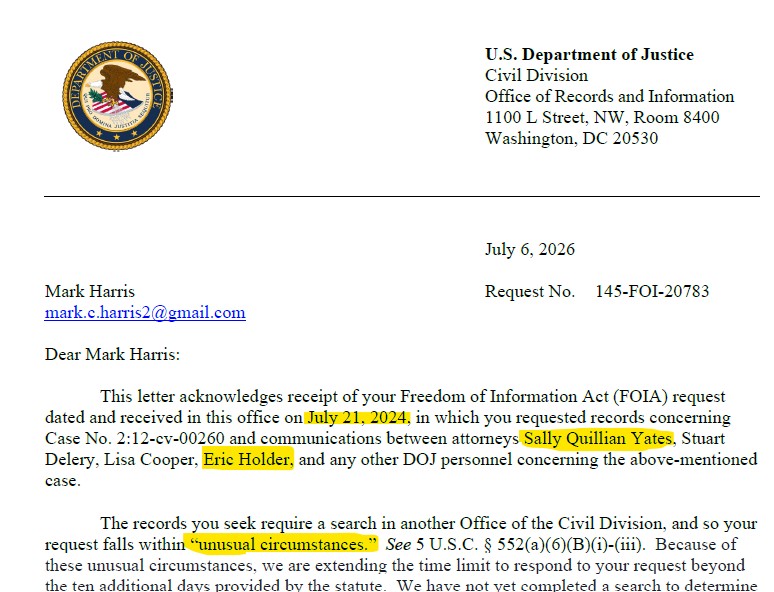
Two years ago, Harris filed a Freedom of Information Act request seeking records related to his lawsuit and communications involving former Attorney General Eric Holder, former Deputy Attorney General Sally Yates, and other Department of Justice officials. Under FOIA, agencies generally must determine within twenty working days whether they will comply with a request. Instead, Harris waited nearly two years before receiving his first substantive response.
Once again, Holder has qutie a bit to hide.
The DOJ’s July 6, 2026, letter acknowledged receipt of the request, classified it under “unusual circumstances,” stated that no search had yet been completed, and advised Harris that the request had been placed into the agency’s complex processing track. After twenty-four months, the Department still had not determined whether responsive records even existed.
To Harris, that response speaks volumes. He argues that bureaucratic delay has become another form of institutional protection, particularly when requests involve politically sensitive subjects or high-ranking officials. His request specifically seeks communications involving Eric Holder, Sally Yates, Stuart Delery, Lisa Cooper, and other DOJ personnel concerning his federal case. Harris believes those records could shed light on decisions surrounding litigation involving his claims.
The federal court’s dismissal of Harris’s lawsuit did not address whether the underlying allegations were true. Rather, the court concluded that the complaint failed to state legally viable claims under applicable pleading standards and dismissed the action during preliminary review. Harris argues that this procedural outcome allowed serious allegations to go unexamined while insulating government actors from meaningful discovery.
At a time when Americans across the political spectrum question whether government institutions operate transparently and impartially, Harris offers a firsthand account of what he believes happens when an individual challenges entrenched power. His story is not merely about one lawsuit; it is about the intersection of politics, prosecutorial discretion, judicial procedure, and public access to government records.
Is the extraordinary delay in responding to a FOIA request simply bureaucratic backlog, or does it illustrate a larger culture of institutional self-protection? Why were communications involving some of the nation’s most senior Justice Department officials sought in the first place? And what does Harris believe those records could reveal if they are ever produced?
Mark Harris is available for television, radio, podcast, and print interviews to discuss his lawsuit, his continuing pursuit of records from the Department of Justice, and why he believes government transparency should not depend on who is asking the questions.
Relevant Article(s):
Document Viewer | The FOIA Project
OPTIONAL Q&A:
- What prompted you to file your original federal lawsuit, and what did you hope it would expose?
- Why do you believe powerful political and legal figures worked to protect the individuals you accused?
- Your FOIA request specifically names Eric Holder and Sally Yates. Why are those names significant to your investigation?
- The Department of Justice took nearly two years to send an initial response to a request that normally requires action within weeks. What does that delay tell you?
- What records or communications do you believe the DOJ is withholding, and why do you think they matter?
- How did the dismissal of your lawsuit affect your ability to obtain evidence through discovery?
- Do you believe your experience reflects broader problems with transparency and accountability inside the Justice Department?
- What would you say to Americans who worry that government agencies sometimes protect powerful insiders instead of pursuing the truth?
ABOUT MARK HARRIS…
Mark Harris is a decorated former Air Force Special Operations pilot who served in a combat zone. He holds a bachelor’s degree in physics from the University of North Georgia (Magna Cum Laude, top physics graduate) and a master’s in Aeronautical Engineering Technology from Arizona State University. Currently, he trains corporate pilots from around the globe and serves as an FAA examiner.
TO SCHEDULE INTERVIEW, CALL OR TEXT 512-966-0983 OR EMAIL BOOKINGS@SPECIALGUESTS.COM