
Deputy Director of National Council of Resistance of Iran on what Removal of Maduro Means for Iranian Regime
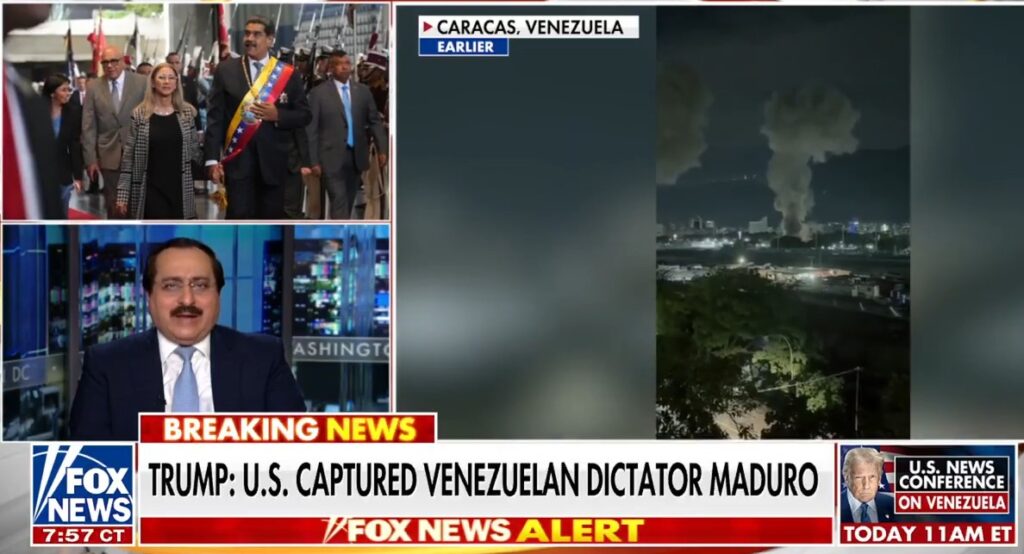
Following the removal of Nicolás Maduro as leader of Venezuela, NCRI Deputy Director Alireza Jafarzadeh appeared on Fox & Friends to discuss the broader geopolitical, regional, and domestic implications of the event. In the interview, Jafarzadeh explained that the removal of a long-standing authoritarian leader, executed with international involvement, highlights the vulnerabilities that entrenched regimes face when confronted with internal unrest, economic instability, and public dissatisfaction. He emphasized that Venezuela’s political upheaval is not only a significant event for Latin America, but also provides important lessons for authoritarian governments worldwide, including Iran.
Jafarzadeh outlined how the Venezuelan case demonstrates that no government, regardless of its ideological foundation or length in power, is immune to public accountability. He noted that Maduro’s regime faced widespread economic collapse, popular protests, and internal corruption that ultimately undermined its capacity to govern effectively. According to Jafarzadeh, the rapid transition in Caracas sends a clear signal to the Iranian regime that systemic weakness, economic mismanagement, and popular discontent can erode even long-established power structures. He argued that these lessons are particularly salient in Iran, where economic hardship, inflation, corruption, and political repression have fueled widespread public frustration and growing calls for reform.
Fox Platform
The conversation also addressed the regional and international implications of Venezuela’s transition. Jafarzadeh pointed out that the event could influence global perceptions of authoritarian regimes, demonstrating that leadership change is possible when a combination of domestic pressure and international attention converges. He suggested that the Iranian leadership should view such examples carefully, recognizing that internal unrest, if left unaddressed, can magnify vulnerabilities and create openings for significant political shifts. Jafarzadeh emphasized that the NCRI advocates for change that comes from within, driven by the will of the Iranian people, rather than external actors imposing solutions.
Bollinger and Jafarzadeh discussed how Maduro’s removal also affects the geopolitical calculus of the Middle East. The Venezuelan example shows that regimes that rely heavily on centralized control, patronage networks, and suppression of dissent are particularly susceptible when economic crises coincide with public outrage. Jafarzadeh drew a parallel with Iran, where entrenched structures such as the Revolutionary Guard and government-linked economic entities may face increasing pressure from citizens demanding accountability, transparency, and systemic reform. He stressed that the Iranian people have long demonstrated resilience and a capacity to organize, and that the lessons of Venezuela underscore the potential impact of grassroots movements in shaping the country’s future.
Throughout the interview, Jafarzadeh highlighted that the NCRI’s position remains consistent: political change in Iran must be determined by its people. While external pressure and international scrutiny are important, they cannot substitute for domestic activism and the collective will of Iranians seeking reform. He cautioned that authoritarian regimes often misread the resilience and determination of their citizens, and that ignoring these signals can lead to rapid and destabilizing outcomes, as demonstrated by the events in Venezuela.
Jafarzadeh concluded by noting that Venezuela’s leadership change is a reminder that political stability is never guaranteed in authoritarian systems. The transition highlights both the risks facing entrenched regimes and the power of public mobilization. For audiences observing Iran and other regions with authoritarian governance, the lesson is clear: systemic weaknesses, combined with domestic activism and external scrutiny, can fundamentally alter political outcomes. The full video of the Fox & Friends interview is available and provides further insight into Jafarzadeh’s analysis of the implications for Iran, the Middle East, and the international community.
Of course, the future of Iran is incredibly linked to the future of Venezuela. By removing Maduro, the U.S. has actually further weakened an already severely weakened Iranian regime.
Fox fox fox fox fox

