
Oil and Powder: Focus on Drug Boats is really a Barrel Roll to Avoid Venezuelan Crude Narrative
American audiences are once again being told that U.S. forces are targeting “drug boats” off Venezuela to stop narcotics from reaching our shores. It’s a clean, simple narrative—easy to support, especially after years of fentanyl deaths. But veteran investigative journalist Bill Conroy, who has spent decades covering U.S.–Mexico dynamics, cartel logistics, covert operations, money laundering, and the overlap between intelligence work and narcotics pipelines, says this new campaign looks far more like a geopolitical squeeze play than a counternarcotics mission.
Are these interdictions really about drugs—or about oil, power, and leverage over America’s rivals?
Conroy points out the obvious contradiction: fentanyl—the drug decimating American communities—comes from Mexico and China, not Venezuela. The vessels being stopped off Venezuela are tied to cocaine, not fentanyl. So why the sudden escalation in a region central to global energy politics—just as Venezuela, China, Iran, and Russia tighten their resource partnerships?
Because, Conroy argues, he who controls production controls the price. And Venezuelan crude is one of the most powerful levers left in the global market. Decreasing that supply, disrupting transport lanes, or exerting de facto maritime dominance can shift pricing power away from China and away from authoritarian energy blocs—and back toward the United States. In the current geopolitical fight, oil is influence, oil is pressure, and oil is leverage.
And history offers a roadmap. In the 1980s, Americans were told we needed to fight communism in Central America—while the CIA simultaneously tolerated, enabled, or ignored cocaine flows into the U.S. The very same government that demonized drug use oversaw an era where cocaine was converted into crack, igniting an epidemic. The public story was ideological. The underlying reality was strategic.
Today, Conroy sees the same pattern emerging. The public-facing justification is narcotics. The underlying objective may be control of a vital energy corridor that shapes China’s access to cheap crude and shifts global market power.
Bill Conroy brings the historical memory, on-the-ground reporting, and geopolitical context needed to explain what’s really driving these operations—and why the drug narrative alone doesn’t add up.
SUGGESTED Q&A
- What evidence suggests the targeting of Venezuelan “drug boats” may be about controlling oil rather than stopping cocaine?
- How does reducing Venezuela’s oil output or maritime reach affect global prices and U.S. leverage over China, Iran, and Russia?
- If fentanyl is the real drug killing Americans—and it comes from Mexico and China—why focus U.S. firepower on Venezuelan waters?
- To what extent does this strategy echo the 1980s, when counternarcotics rhetoric masked deeper geopolitical objectives?
- How does the U.S. benefit by exerting maritime pressure on a nation whose crude supply shapes global energy markets?
- Is the drug-war framing simply the most politically palatable way to justify operations that are really about resource control?
- What do we know about the intelligence community’s past use of narcotics conflicts as covers for strategic interventions?
- How would China’s energy security be affected if Venezuelan oil exports were reduced, disrupted, or quietly redirected?
Related Article(s)
Trump sanctions Maduro’s nephews, 6 ships carrying Venezuela oil
Get the Facts: Is Venezuela a primary drug trafficker to the United States?
ABOUT BILL CONROY…
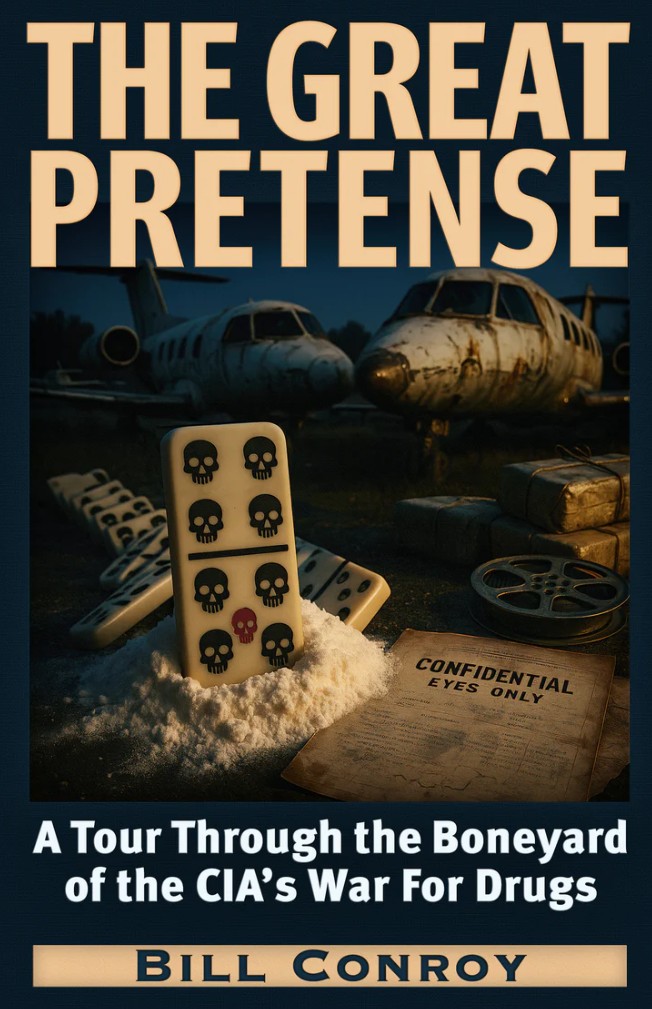
Bill Conroy, M.A. in Mass Communications/Journalism (Marquette University), is a veteran journalist with 40 years of experience working as a staff reporter, editor-in-chief, and freelance correspondent at print and online publications across the United States and in Mexico. His journalism has been cited in more than 35 books to date. Conroy also is the author of the nonfiction books The Great Pretense: A Tour Through the Boneyard of the CIA’s War for Drugs; Dispatches from the House of Death: A Juarez Cartel informant, a DEA whistleblower, mass murder and a coverup on the edge of the Empire; and Borderline Security: A Chronicle of Reprisal, Cronyism and Corruption in the U.S. Customs Service.
TO SCHEDULE AN INTERVIEW, CALL OR TEXT 512-966-0983 OR EMAIL BOOKINGS@SPECIALGUESTS.COM