Group Think Tank: From COVID to the Charlie Kirk Investigation to Voting, Dissent is Being Punished
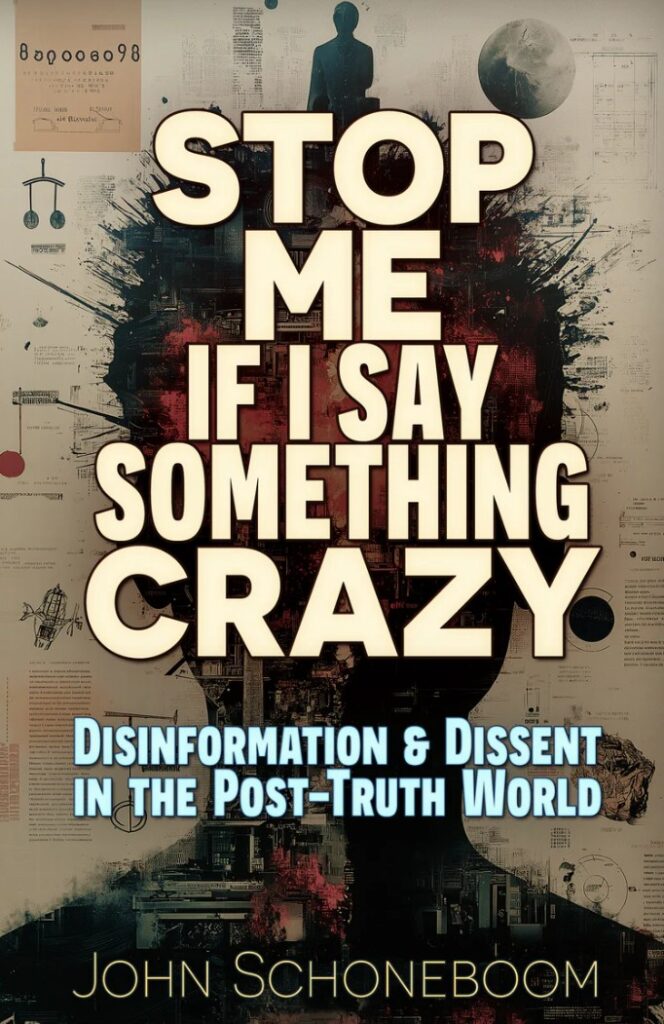
Public confidence in institutions is collapsing. Whether discussing COVID Vaccines, Voting Machines, Climate Change, or even the Charlie Kirk investigation, there are required views and forbidden views. In Stop Me if I Say Something Crazy: Disinformation and Dissent in the Post-Truth World, author and PhD John Schoneboom argues that today’s fiercest battles aren’t over facts as much as they are over who gets to ask questions without being branded a heretic.
- Required views often reveal who holds cultural power.
- Questioning accepted narratives is increasingly treated as dissent.
- COVID exposed the shrinking space for open scientific debate, says PhD
- Disinformation labels can discourage legitimate public inquiry, says PhD.
- Free societies depend on protecting unpopular questions as much as popular answers.
PhD has the Remedy
Rather than separating opinions into “true” and “false,” PhD Schoneboom says our culture increasingly sorts them into “required” and “forbidden.” The required view is the one endorsed by governments, media, corporations, and other cultural gatekeepers. The forbidden view isn’t necessarily disproven—it simply falls outside the boundaries of acceptable public discussion. Once an opinion crosses that line, those expressing it often find themselves labeled as conspiracy theorists, extremists, or spreaders of disinformation, regardless of the evidence they present.
The COVID pandemic (think Anthony Fauci) became one of the clearest examples of this phenomenon. For years, the required view held that the vaccines were unquestionably beneficial, while questions about effectiveness, mandates, side effects, or long-term safety were frequently dismissed or censored. Schoneboom says the larger issue isn’t whether every skeptical claim proved correct, but why merely asking difficult questions became socially unacceptable. When debate itself becomes taboo, science gives way to ideology.
He believes the same dynamic is now playing out across countless issues, including the investigation into the assassination of Charlie Kirk. Those who accept the dominant narrative surrounding the case generally occupy the “required view,” while those asking uncomfortable questions about the investigation often find themselves pushed into the realm of the forbidden. Schoneboom stresses that this is not about endorsing any particular theory but about recognizing how quickly society now equates skepticism with guilt.
Schoneboom contends that whenever disagreement becomes morally unacceptable instead of intellectually debatable, citizens should pay close attention. The louder people are told that certain questions must never be asked, the more important it becomes to ask why. He says understanding the difference between a required view and a forbidden view may be one of the most valuable tools for navigating today’s post-truth world—and for preserving free inquiry before it disappears altogether.
Relevant Article(s):
GOP lashes out as Fauci refuses to answer questions: Five takeaways
OPTIONAL Q&A:
- What separates a “required view” from a “forbidden view” in today’s culture?
- Why do some questions become socially unacceptable before they’re ever answered?
- Did COVID expose a growing intolerance for scientific dissent?
- Has the label “disinformation” become a tool for silencing debate?
- What can the public learn from the competing narratives surrounding the Charlie Kirk investigation?
- How do media and political institutions determine which opinions are considered acceptable?
- Why is the freedom to ask unpopular questions just as important as the freedom to express popular opinions?
- What does the rise of “required thinking” mean for the future of free speech and open inquiry?
ABOUT JOHN SCHONEBOOM…
John Schoneboom is a PhD and an award-winning author, essayist, and cultural critic whose work explores the fragile, often “fungible” nature of reality, perception, and belief. Blending political analysis, satire, philosophy, and surrealism, he challenges readers to question accepted narratives and embrace intellectual curiosity. Schoneboom holds a PhD and an MA in Creative Writing from Northumbria University, an MA in Science, Technology, and International Affairs from The George Washington University, and a BA in Political Science from Hampshire College. A recipient of the Massachusetts Cultural Council Artists’ Fellowship and the Northern Writers’ Award, he is the author of Surrealpolitik and several works of innovative fiction.
TO SCHEDULE AN INTERVIEW, CALL OR TEXT 512-966-0983 OR EMAIL BOOKINGS@SPECIALGUESTS.COM