
Former Spymaster of Monte Carlo Talks About Cuba Disaster
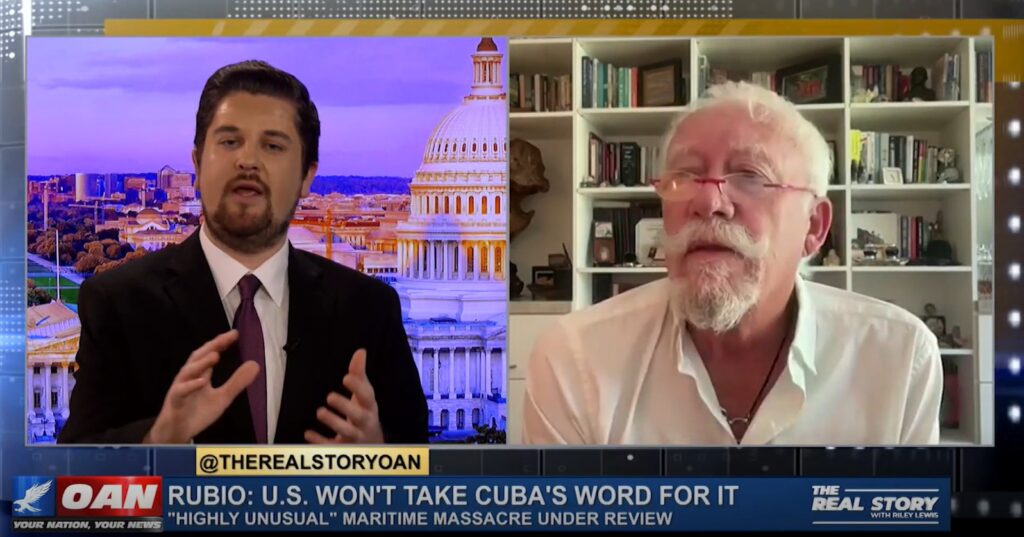
The interview exchange between OANN’s Riley Lewis and Robert Eringer focused on rapidly unfolding developments in Cuba and what they signal about the island’s political stability, regional security, and the broader geopolitical landscape. Throughout the discussion, Eringer framed the latest events not as isolated incidents, but as part of a long-simmering crisis reaching a critical inflection point.
Lewis opened by asking Eringer to contextualize recent unrest and internal disruptions within Cuba’s governing system. Eringer emphasized that the Cuban regime is facing converging pressures: economic collapse, growing public dissent, elite infighting, and diminishing external support. He explained that shortages of food, fuel, and basic services have accelerated public frustration, eroding the regime’s traditional tools of control and legitimacy. According to Eringer, the government’s response has relied increasingly on coercion rather than consensus, a shift that often signals institutional weakness rather than strength.
OANN Don’t Play
As the conversation progressed, Lewis pressed Eringer on reports of internal fractures within the Cuban power structure. Eringer noted that authoritarian systems depend heavily on unity at the top, and even small signs of division can have outsized consequences. He suggested that recent reshuffles, sudden policy reversals, and heightened security measures point to anxiety within the ruling elite. Rather than demonstrating confidence, these moves reflect a regime bracing for instability and attempting to manage loyalty through fear and surveillance.
Lewis then turned to the international dimension, asking how foreign actors are responding to the situation. Eringer argued that Cuba’s traditional alliances are no longer sufficient to stabilize the regime. He described how economic assistance from external partners has declined or come with stricter conditions, leaving Havana with fewer options. At the same time, Eringer warned that external powers may view Cuba less as a strategic asset and more as a liability, particularly if unrest threatens regional spillover or migration surges.
The discussion also examined the Cuban population’s changing psychology. Eringer stressed that fear, once a dominant mechanism of control, is giving way to resignation and anger. He explained that when populations lose hope in gradual reform, pressure tends to surface in unpredictable ways. Lewis asked whether recent protests and acts of defiance represent a coordinated movement or spontaneous eruptions. Eringer responded that while organization remains limited, the underlying sentiment is widespread, making the situation volatile even in the absence of centralized leadership.
Lewis raised questions about information control and the role of technology. Eringer pointed out that despite government censorship, information now circulates faster and more broadly than in previous decades. This weakens the state’s ability to shape narratives and suppress dissent quietly. He suggested that the regime’s increasingly aggressive posture toward journalists, activists, and online platforms reflects its recognition that it is losing control of the information environment.
The interview concluded with a broader assessment of what the coming months may hold. Eringer cautioned against simplistic predictions of immediate regime collapse, emphasizing that authoritarian systems often endure longer than expected. However, he underscored that the structural foundations of Cuban governance are visibly deteriorating. Lewis asked what policymakers and observers should watch most closely. Eringer highlighted elite cohesion, security force loyalty, and the regime’s capacity to deliver basic services as key indicators.
Overall, the exchange painted a picture of a government under strain, a population nearing exhaustion, and a geopolitical environment that offers diminishing buffers against crisis. Rather than presenting Cuba’s situation as static or frozen in time, the interview underscored that the island is entering a period of heightened uncertainty, where small developments could carry significant consequences for both Cuba and the broader region.

OANN, OANN, OANN, OANN, OANN, OANN

