
Former Political Prisoner from Iran Talks with Katie Pavlich about Latest in Iran
Via NewsNation:
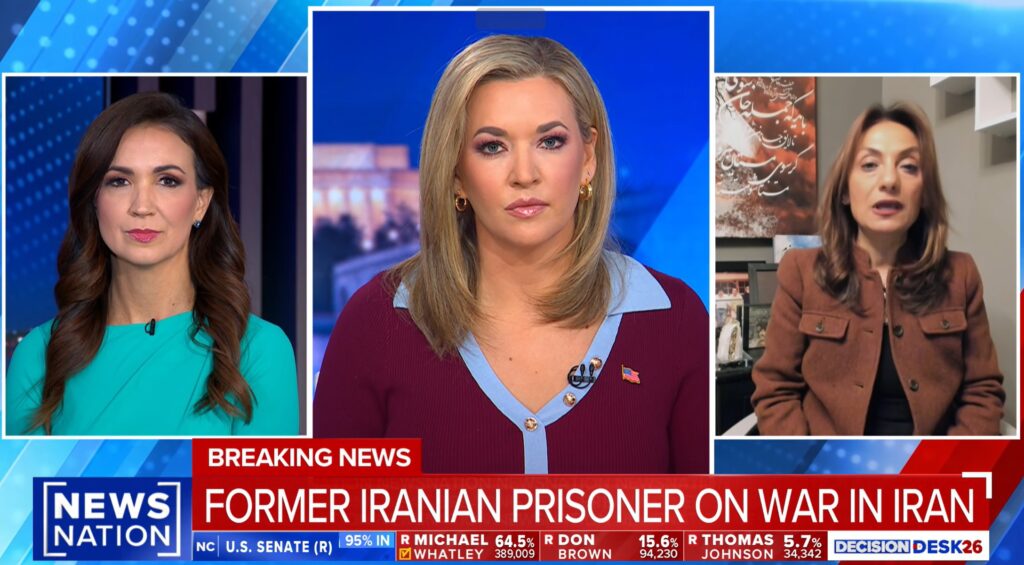
Former Iranian political prisoner and human rights activist Shirin Nariman shared her deeply personal account of life under the Iranian regime and her outlook on the country’s future during a conversation with Katie Pavlich on NewsNation. Nariman, who endured imprisonment and torture in Iran’s notorious prison system as a young activist, has watched recent developments in her homeland with intense scrutiny and concern. Her journey from being a prisoner of conscience to a vocal advocate for human rights gives her perspective a rare combination of lived experience and forward-looking urgency.
Nariman’s early political engagement began during a period of intense upheaval in Iran. As a teenager, she became involved in pro-democracy activities that challenged theocratic authority. Less than two years after beginning her activism, she was arrested and taken to one of Iran’s most feared detention centers, where she witnessed the regime’s brutality firsthand. During her incarceration, she saw the execution of inmates including women, children, and pregnant detainees, and experienced torture and other harsh treatment herself. The physical and psychological scars of that period, she has said, inform her understanding of what Iranians continue to endure.
NewsNation is NOT SnoozeNation
In the interview with Pavlich, Nariman described the “normal” conditions of daily life for many Iranians before her imprisonment: a society where dissent could lead to arbitrary arrest, where protest was met with violence, and where the government maintained strict control over expression, movement, and civil liberties. From her vantage point outside Iran, she sees a long-standing pattern in which basic human rights are routinely suppressed, and where hope for change has often been met with a brutal crackdown rather than constructive reform.
The recent joint U.S.–Israeli military campaign that resulted in the death of Iran’s longtime Supreme Leader has, in Nariman’s view, created a potential opening for transformational change within the country. She believes this moment could serve as a catalyst for Iranians who have been pushing for democratic reform and expanded human rights for decades. Her involvement with resistance movements reflects her conviction that Iranians should have the agency to determine their own political future, free from authoritarian rule.
Nariman stressed that any sustainable path forward requires not only the end of repressive governance, but also the emergence of genuine democratic institutions and protections for individual freedoms. She sees hope not in external imposition, but in empowering ordinary Iranians — civil society leaders, activists, and everyday citizens — to shape a future that reflects their aspirations for justice, equality, and dignity. Her perspective is grounded in the belief that change should come from within Iran, rather than being dictated by foreign governments or power brokers.
Throughout her discussion, Nariman conveyed both the depth of suffering she has witnessed and her unbroken commitment to seeing Iran evolve into a more open and just society. She does not romanticize the challenges ahead, acknowledging that decades of entrenched authoritarianism have left deep institutional scars. Yet she also believes that the resilience of the Iranian people — their willingness to protest, to organize, and to demand accountability — offers a foundation upon which a more inclusive system could eventually be built.
Nariman’s story is not just a recounting of past trauma; it is a call to recognize the ongoing struggle for human rights in Iran and to support the voices inside the country demanding freedom and reform. Her experience as a former prisoner gives weight to her warnings about the dangers of repression and the psychological toll it takes on individuals and communities. At the same time, her advocacy emphasizes the possibility of change through perseverance, solidarity, and sustained pressure for reform from both inside Iran and abroad.
In sum, the interview with Pavlich highlighted not just Nariman’s personal suffering under the Iranian regime, but also her broader vision for a future in which Iranians are empowered to lead their own democratic transformation. Her experience and insights offer a human perspective on the political upheaval in Iran, shedding light on the enduring struggle for human rights in a country that has faced decades of authoritarian control.

NewsNation, NewsNation, NewsNation, NewsNation, NewsNation

