Abbey Roadkill: Beatles Fans Became Conspiracy Detectives on a Long and Winding Hoax About McCartney’s Death
Someone put forth a bizarre rumor that Paul McCartney secretly died in a 1966 car crash and was replaced by a lookalike (sound like a Jim Carrey rumor today?). Who had the power to make the “Paul is Dead” rumor stick? That may just be an easy question to answer, based on how much traction it got. More than half a century later, McCartney himself is now admitting the rumor carried a deeper truth than even he realized.
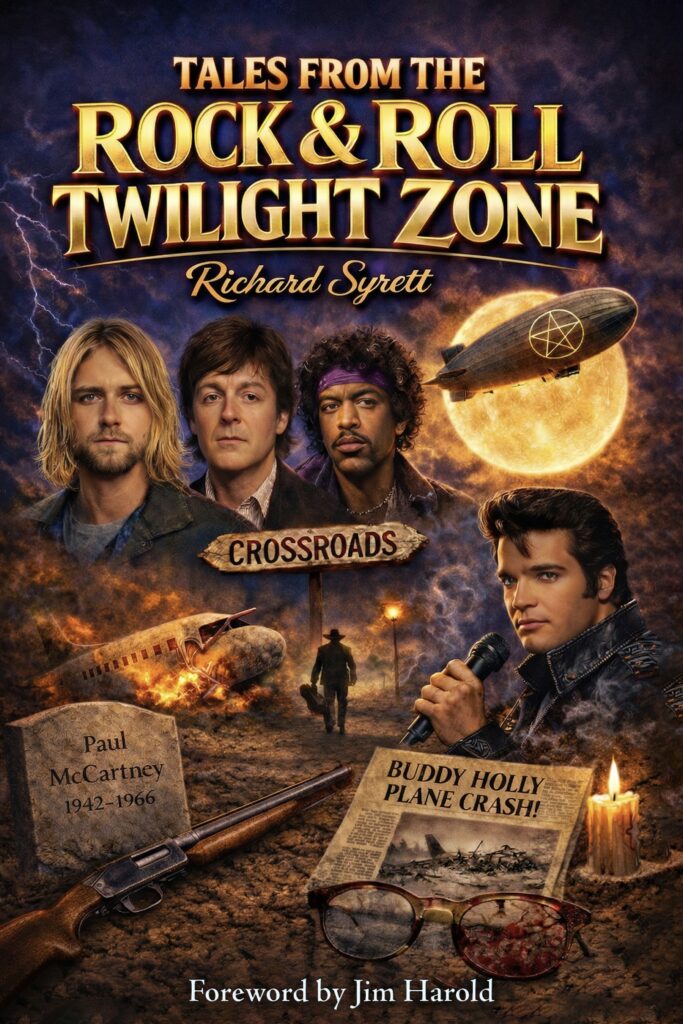
Podcast and talk radio veteran Richard Syrett (pronounced like “carrot” with an “s”)—host of the Strange Planet podcast and frequent voice behind Coast to Coast AM—dives deep into rock’s most enduring mysteries in his provocative new book, Tales from the Rock and Roll Twilight Zone.
CLICK HERE TO LEARN MORE ABOUT RICHARD SYRETT’S BOOK, TALES FROM THE ROCK & ROLL TWILIGHT ZONE
- “Paul is Dead” became conspiracy culture before the internet existed.
- McCartney admitted the rumor carried symbolic truth.
- Psychedelia blurred lines between reality, performance, and paranoia.
- Fans decoded Beatles lyrics like hidden intelligence messages.
- The Beatles’ breakup fueled rumors of identity and replacement.
That revelation opens the door to a far more fascinating conversation for Syrett, not about whether McCartney literally died, but about how one of the most enduring conspiracy theories in pop culture emerged at the exact moment The Beatles entered its psychedelic, experimental, and psychologically turbulent era.
The theory exploded, going mainstream in 1969 as fans dissected Beatles lyrics, album covers, backward messages, and cryptic imagery searching for “clues.” Barefoot on Abbey Road. “I buried Paul.” Funeral symbolism. Hidden meanings. Millions went down rabbit holes long before the internet existed.
Yet the timing matters.
The Beatles’ transformation from clean-cut pop icons into counterculture avatars coincided with an era now known to include real government mind-control experimentation through programs like MK-Ultra. While there may not be smoking gun evidence the Beatles were connected to such operations, the broader cultural atmosphere of altered consciousness, psychedelia, media manipulation, and mass psychological influence was undeniably real. That environment helped fuel public paranoia and made increasingly surreal narratives seem plausible.
Most intriguingly, McCartney now says the rumor affected him psychologically enough that even he began questioning the symbolic meaning behind it. Reflecting on the band’s collapse and his own identity crisis, McCartney admitted: “In so many ways, I was dead.”
That metaphorical death — the death of “Beatle Paul” — may explain why the theory endured. The public instinctively sensed something had changed. The old Beatles were disappearing. Fame, lawsuits, drugs, internal feuds, and cultural upheaval were tearing apart the biggest band on Earth. McCartney retreated to rural Scotland, isolated from London and increasingly detached from the persona the world knew.
Syrett can explore how the “Paul is Dead” phenomenon became the prototype for modern conspiracy culture: crowdsourcing clues, decoding symbolism, distrusting official narratives, and blurring the line between metaphor and reality. Long before QAnon or internet sleuths, Beatles fans were already building an alternate reality out of hidden messages, media mythology, and cultural anxiety.
In hindsight, the real story may not be whether Paul died — but why so many people needed to believe he had.
Relevant Article(s):
Paul McCartney Confesses ‘Paul Is Dead’ Theory Had Truth Behind It After 50 Years – Parade
OPTIONAL Q&A:
- What did Paul McCartney mean when he said the “Paul is Dead” rumor was “more accurate” than people realized?
- Why did the “Paul is Dead” theory resonate so deeply with fans in the late 1960s?
- How much did The Beatles’ psychedelic transformation fuel public paranoia and symbolic thinking?
- Did the rise of drug culture and altered consciousness make audiences more vulnerable to conspiracy narratives?
- What role did album art, hidden symbolism, and backward messaging play in creating the first mass-media conspiracy theory?
- How did the breakup of The Beatles metaphorically “kill” the version of Paul McCartney the world once knew?
- Why do conspiracy theories often emerge during periods of rapid cultural and psychological change?
- Did the “Paul is Dead” phenomenon lay the groundwork for modern internet rabbit-hole culture?
- Could the MK-Ultra revelations decades later have caused people to revisit old cultural conspiracies differently?
- Why are people still fascinated by the idea that celebrities are secretly replaced or manufactured?
ABOUT RICHARD SYRETT…
Richard Syrett is the host of the popular and critically acclaimed podcast, Richard Syrett’s Strange Planet. He has built his reputation as an accomplished teller of spell-binding tales, and a keen interviewer in the arena of the unexplained.
He is a regular guest-host on Coast to Coast AM, the most-listened-to, late-night radio program in the world.
Beginning in 2010, Richard created, wrote, produced and hosted five seasons of The Conspiracy Show, a documentary-style television program which aired across Canada, Australia, parts of Europe and Africa.
In 2013 he co-starred in a pilot for The Discovery Channel in the U.S. called The United States of Paranoia, which investigated claims of electronic harassment and mind control.
In 2018 Richard created, wrote, and hosted the critically acclaimed podcast The Rock ‘n Roll Twilight Zone on Westwood One and The Chris Jericho podcast network.
He is a much sought-after expert on all things unexplained and has appeared on numerous television series, including: William Shatner’s Weird or What?; National Park Mysteries; and Freak Encounters.
Richard and The Mighty Aphrodite are parents to twin boys and reside just north of Toronto, Canada. Visit Syrett’s website Here: Richard Syrett’s Strange Planet | Alternative, UFO, Paranormal Radio and Podcast
TO SCHEDULE AN INTERVIEW, CALL OR TEXT 512-966-0983 OR EMAIL BOOKINGS@SPECIALGUESTS.COM