
NCRI Spokesman Discusses the Impending fall of the Iranian Regime
Via the Matt Gaetz Show on OANN:
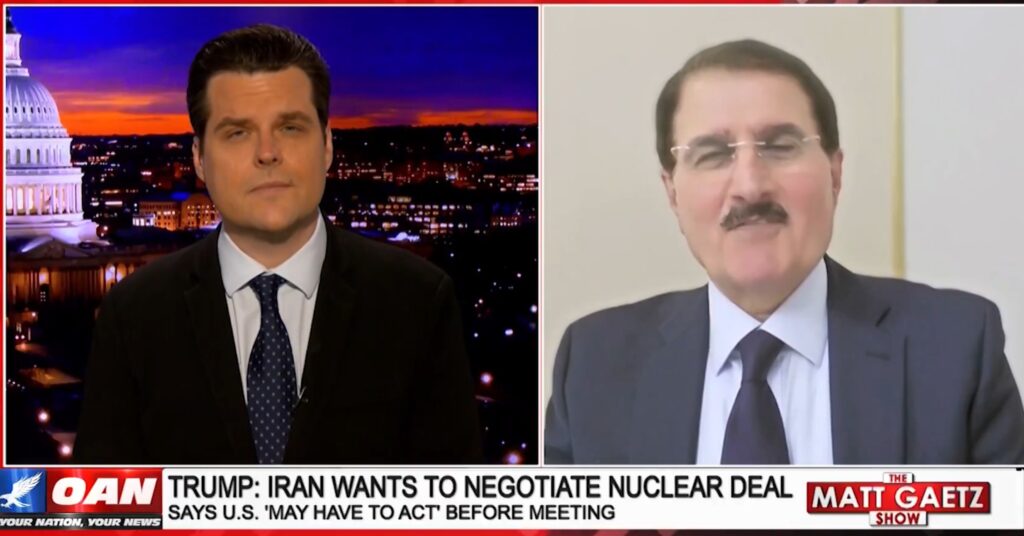
The interview between the National Council of Resistance of Iran’s Ali Safavi and OANN host Matt Gaetz focused on the rapidly escalating confrontation between the Iranian regime and its own population, with particular attention to the regime’s use of internet shutdowns as a primary tool of repression. Safavi framed the communications blackout not as a temporary security measure, but as a deliberate strategy aimed at isolating protesters, preventing coordination, and concealing the scale of unrest from both Iranians and the international community.
Safavi explained that nationwide protests have expanded beyond major cities into smaller towns and provinces, stretching the regime’s security forces thin. As demonstrations intensify, authorities have repeatedly throttled or completely cut internet access, disrupting messaging apps, social media platforms, and independent news outlets. According to Safavi, this tactic reflects the regime’s fear that unrestricted information flow would accelerate the collapse of its control by allowing citizens to organize more effectively and by exposing violent crackdowns to the outside world.
Gaetz pressed Safavi on how critical digital connectivity has become to modern protest movements. Safavi emphasized that access to the internet now functions as both a lifeline and a shield. Protesters rely on it to coordinate demonstrations, warn one another of security force movements, and document abuses. When that access is removed, the regime gains tactical advantage, not only by sowing confusion among demonstrators but also by suppressing evidence of repression that could galvanize international pressure.
Gaetz on Starlink
A significant portion of the discussion centered on the potential role of satellite-based internet services, particularly Starlink, as a means of bypassing state-controlled infrastructure. Safavi described Starlink as a transformative tool that could neutralize the regime’s most effective censorship weapon. By enabling decentralized, satellite-driven connectivity, such technology would make it far more difficult for authorities to impose blanket shutdowns or monitor communications at scale.
Safavi noted that the Iranian resistance has long sought ways to break the regime’s monopoly on information, arguing that the current uprising has reached a stage where external technological support could meaningfully alter the balance of power. He underscored that providing secure internet access is not merely a technical issue but a humanitarian and moral one, as it allows citizens to communicate, seek help, and tell their stories without fear of immediate suppression.
Gaetz raised questions about international responsibility and whether Western governments are prepared to move beyond statements of concern. Safavi responded by outlining the disconnect between rhetorical support for human rights and the lack of decisive action to protect Iranian civilians. He argued that enabling access to uncensored internet would be a concrete step that avoids military escalation while directly empowering the Iranian people.
The interview also addressed the broader implications of the protests for regime stability. Safavi characterized the current unrest as qualitatively different from past demonstrations, citing its persistence, geographic spread, and the growing boldness of protesters despite lethal crackdowns. He stressed that the regime’s reliance on internet shutdowns is itself evidence of vulnerability, revealing an inability to control the population through legitimacy or persuasion.
Throughout the conversation, Safavi framed the struggle in Iran as one between a population demanding basic freedoms and a ruling system sustained through surveillance, censorship, and force. He emphasized that technology now sits at the center of this confrontation. Where the regime depends on isolation, the resistance depends on connection.
The discussion concluded with an emphasis on urgency. Safavi warned that without sustained attention and practical support, the regime will continue to exploit information blackouts to suppress dissent in the dark. At the same time, he expressed confidence that tools like satellite internet, combined with the determination of the Iranian people, could undermine the regime’s efforts to control the narrative and ultimately hasten meaningful change.