
Lyme Tree: Roots of Deadly Disease Reveal Origins the U.S. Government Does NOT want You to Question
A recent discussion on The Joe Rogan Experience has reignited interest in one of America’s most mysterious illnesses. In a clip that has already drawn more than three million views, Rogan explored the question of where Lyme disease actually came from and whether its origins in the United States are as straightforward as commonly believed. For Lyme disease survivor and researcher Adam Finnegan, that question is not theoretical—it has been the focus of years of investigation.
- Follow the roots: Trace Lyme disease back far enough and the trail leads to Erich Traub — a Nazi biowarfare scientist later brought into U.S. research programs.
- Operation Paperclip’s dark side: The same program that imported German rocket scientists also welcomed experts in biological warfare onto American soil.
- Espionage twist: Traub reportedly interacted with a British intelligence figure later exposed as a Soviet double agent, raising the specter of compromised U.S. research.
- The vaccine mystery: The first Lyme vaccine wasn’t pulled because of weak demand, Finnegan argues—mounting reports of adverse effects made it commercially and politically untenable.
- From sickness to investigation: After surviving Lyme disease himself, Finnegan spent years assembling documents, timelines, and historical records that challenge the official origin story.
Finnegan describes the history of Lyme disease like a family tree: the symptoms are the visible branches, the outbreaks are the trunk, but the real story lies buried in the roots. Follow those roots carefully enough, he says, and they lead back to a surprising and controversial lineage involving wartime biological research, Cold War intelligence intrigue, and a scientist whose past stretches back to Nazi Germany.
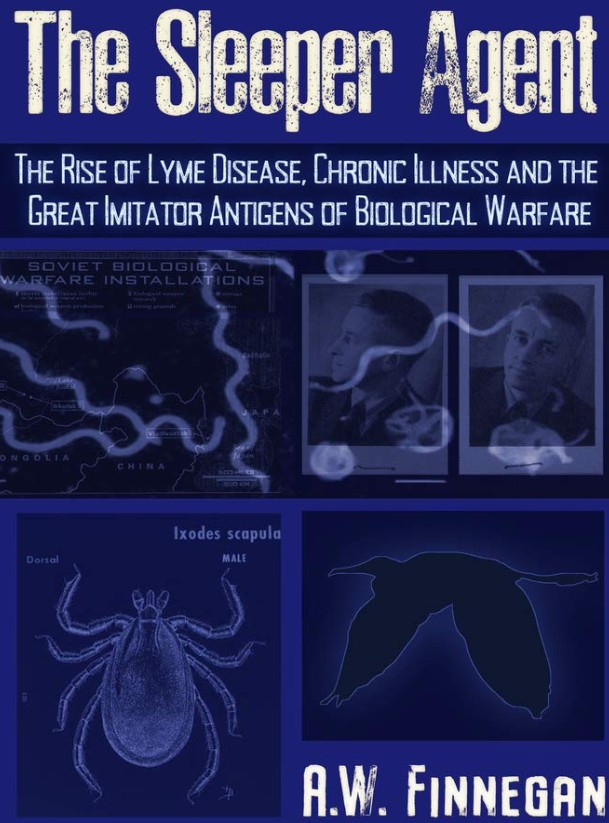
Finnegan, whose book The Sleeper Agent: The Rise of Lyme Disease, Chronic Illness, and the Great Imitator Antigens of Biological Warfare lays out a deeply documented case that Lyme disease—and possibly HIV/AIDS—trace back to covert bioweapons research. There are clear similarities between how Lyme disease vaccines and COVID vaccines were rushed to market and led to adverse effects many fought to suppress.
What started as a personal quest for answers evolved into a deeper investigation of historical records, scientific papers, and declassified government material. The name that repeatedly surfaced in his research was Erich Traub, a German Nazi virologist who conducted biological research during the Third Reich and later came to the United States after World War II under programs associated with Operation Paperclip, which brought numerous German scientists into American research institutions.
Traub’s expertise focused heavily on animal-borne and insect-transmitted diseases—exactly the type of pathogens that later became central to Lyme disease discussions. Finnegan argues that this overlap raises important historical questions about how such research evolved on American soil and whether experiments connected to vector-borne illnesses may have contributed to the emergence of Lyme disease in the United States.
Complicating the story further are historical accounts suggesting that Traub maintained connections to intelligence networks during the early Cold War period. Some reports describe his interactions with a British intelligence figure who was later revealed to be a double agent working for the Soviet Union. If accurate, Finnegan says, it would mean that sensitive biological research involving a former Nazi scientist may have been operating in an environment already compromised by espionage.
The controversy surrounding Lyme disease resurfaced again decades later when vaccines intended to prevent the illness were introduced and then abruptly withdrawn. Pharmaceutical companies publicly attributed the decision to poor sales. Finnegan argues that explanation overlooks a key factor: growing concerns about adverse reactions reported by patients. While the official explanation emphasized market demand, he believes the public deserves a clearer understanding of what actually drove the decision.
Finnegan does not frame his work as speculation but as documentation. Over years of research, he has assembled timelines, scientific references, and historical records that he believes warrant closer scrutiny. With Lyme disease once again entering public conversation—thanks in part to Rogan’s widely viewed discussion—Finnegan says the moment has arrived to reexamine the roots of the disease and the complicated history that may lie beneath them.
Relevant Article(s):
OPTIONAL Q&A:
- What first led you, as a Lyme disease survivor, to begin investigating the historical origins of the disease rather than simply focusing on treatment and recovery?
- When you trace the “family tree” of Lyme disease back through scientific research and historical records, where do the roots ultimately lead?
- Who was Erich Traub, and why does his work during and after World War II raise questions about the early development of vector-borne disease research in the United States?
- How did Operation Paperclip bring scientists like Traub into American research programs, and what risks did that decision create during the early Cold War?
- What evidence have you uncovered that suggests Lyme disease research may intersect with biological experimentation on U.S. soil?
- Why do you believe the official explanation for the withdrawal of early Lyme vaccines—lack of sales—does not tell the full story?
- What parallels do you see between the public debate over Lyme vaccines and the broader controversies surrounding pharmaceutical transparency and safety?
- Joe Rogan recently brought the origins of Lyme disease back into public conversation with millions of viewers—why do you think the topic is suddenly gaining renewed attention now?
ABOUT A.W. (ADAM) FINNEGAN…
Adam Finnegan is a survivor of Lyme disease and immune tolerance and has been battling health problems since he was young, with the onset of a chronic disease in 2016. He is a writer, graphic artist and designer, and avid reader and researcher of history, biological warfare, esoteric philosophy, spirituality, and the Western Mystery Traditions. He has made a special study of the life and work of Erich Traub and the science of immune tolerance. He has collected and translated to English all of Traub’s published research. He lives in Cape Cod, Massachusetts, peacefully by himself, where he enjoys BMX biking, fitness, study, the arts, and self-development.
TO SCHEDULE AN INTERVIEW, CALL OR TEXT 512-966-0983 OR EMAIL BOOKINGS@SPECIALGUESTS.COM