
Homegrown Overthrow: Iran’s Opposition says Regime Change Must come from Within, not from U.S. Missiles
As negotiators return to Geneva to debate whether the next phase of Iran policy leads toward restraint or military confrontation, a crucial voice is missing from the public conversation: one that rejects war with the regime while refusing to normalize the it. Robert Torricelli, speaking as a spokesman for the National Council of Resistance of Iran (NCRI), can bridge that divide. At a moment when Americans overwhelmingly oppose another Middle East war but remain deeply hostile to Tehran’s theocracy, Torricelli and the NCRI offer a third path—regime change by the people themselves.
NCRI Speakers Available:
Robert G. Torricelli: Former U.S. Senator, NCRI Spokesman
Alireza Jafarzadeh: Deputy Director of NCRI
Shahin Gobadi: Member of NCRI Parliament in Exile
Ali Safavi: Member of NCRI Parliament in Exile
***REQUEST AN EXCLUSIVE, HIGH QUALITY VIDEO CLIP FROM NCRI PRESIDENTIAL NOMINEE MARYAM RAJAVI REQUESTING NO FOREIGN MILITARY INTERVENTION***
- Regime change without war: people overthrowing the regime themselves is both morally legitimate and strategically stronger than foreign intervention.
- Foreign force backfires: Military action risks rescuing the regime, fracturing the opposition, and attaching permanent geopolitical strings.
- Women-led resistance: The movement the regime fears most is internal, organized, and increasingly led by women, not armies.
- Rhetoric vs. reality: Tehran’s arrests and killings of MEK fighters signal weakness, not strength—and a regime under real pressure.
- What the West should do: Unified political backing and tough sanctions empower the people without hijacking their revolution.
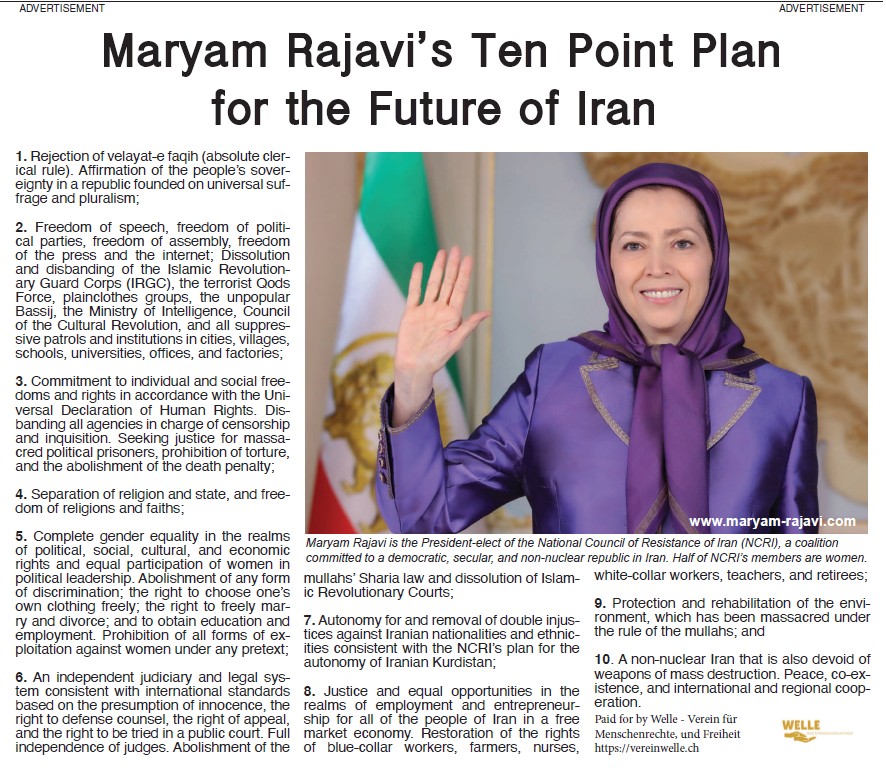
The NCRI’s position is explicit and often misunderstood: no foreign military intervention. Not because the regime is stable or legitimate, but because imposed change—however well-intentioned—always comes with strings. History shows that outside military action reshapes a country’s future in ways its people cannot control. The NCRI argues that peole want political solidarity, economic pressure, and moral clarity from the West—not bombs, bases, or “liberation” armies.
That distinction matters now, as Geneva the talks quietly drift toward the familiar logic of escalation. Torricelli can explain why opposing war does not mean tolerating the regime. Sanctions, diplomatic isolation, and unified international condemnation strengthen internal resistance; war consolidates the regime’s narrative and weakens the opposition it fears most.
That fear is already visible. Recent reports of **People’s Mujahedin of Iran (MEK) fighters storming regime headquarters—and Tehran’s own claim that it killed or arrested roughly 100 of them—are not signs of control. They are signs of anxiety. Authoritarian governments do not advertise crackdowns unless unrest is spreading. The uprising is no longer theoretical; it is increasingly organized, increasingly bold, and increasingly costly for the regime to suppress.
At the center of this movement is Maryam Rajavi, the NCRI’s nominee for president. Her message is unambiguous: the people will overthrow this regime themselves. They ask the world not for soldiers, but for solidarity—sanctions that target the regime, diplomatic recognition of the resistance, and a unified voice that denies Tehran legitimacy. Rajavi also highlights the fact that women are capable of leading the country once the misogynistic regime falls.
A Washington Examiner article (linked below) highlights that the regime’s deepest fear is not foreign pressure but the women-led resistance movement inside that country, which has become a powerful force for change through years of sacrifice and grassroots organization. It centers on Rajavi’s leadership, noting how she empowered women within the resistance to take active roles and sustain morale under brutal conditions. The piece argues that this movement—with women at its core—is harder for the regime to suppress than external military force because it speaks the language of internal defiance and embodies a sustained, indigenous challenge to clerical rule that ultimately threatens the regime’s survival.
Torricelli can argue that Geneva’s real choice is not war versus peace, but intervention versus empowerment. Let the Iranian people finish what they have already begun.
Relevant Article(s):
U.S.-Iran nuclear negotiators meet for 3 hours with Trump decision looming
The women-led resistance the Iranian regime fears most
Iran News in Brief – February 26, 2026 – NCRI
OPTIONAL Q&A:
- How can the United States oppose another war with Iran while still taking a firm stand against the ruling regime?
- Why does the NCRI reject foreign military intervention even as unrest inside Iran intensifies?
- What role can sanctions and diplomatic isolation play in accelerating regime change without empowering Tehran’s hardliners?
- How do recent reports of MEK fighters storming regime headquarters change the timeline for potential overthrow?
- Why does the Iranian regime publicize arrests and killings if it is truly in control?
- What distinguishes popular regime change led by Iranians from externally imposed “solutions” that have failed elsewhere?
- How does Maryam Rajavi’s leadership challenge both the clerical regime and Western assumptions about Iran’s future?
- What can democratic governments do right now to support the Iranian people without undermining their independence?
ABOUT ROBERT G. TORRICELLI…
Senator Robert Torricelli served 14 years in the U.S. House of Representatives, representing the 9th district of New Jersey until January 1997, when he was elected as Democratic Senator from the state of New Jersey. While in the Congress, he was the leading voice for a free Iran and has been advocate of a free and democratic Iran for the past three decades.
In 1999, he joined the Democratic Leadership as the chair of the Democratic Senatorial Campaign Committee.
Senator Torricelli served in the House Foreign Affairs Committee as the chairman of the House Subcommittee on the Western Hemisphere.
Senator Torricelli earned his law degree from Rutgers University and completed a Master of Public Administration from Harvard University’s John F. Kennedy School of Government.
Before becoming a member of the U.S. Congress, Torricelli served as associate counsel to then-Vice President Walter Mondale.
ABOUT ALIREZA JAFARZADEH…
Alireza Jafarzadeh serves as the Deputy Director of the Washington Office of the National Council of Resistance of Iran (NCRI). He is also the author of The Iran Threat (Palgrave MacMillan, New York, 2008).
A recognized expert on Iranian policy, Jafarzadeh has been at the forefront of efforts to prevent the Iranian regime from acquiring nuclear weapons. His groundbreaking work in 2002 and 2003 led to the discovery of key illicit nuclear sites in Iran, including the Natanz uranium enrichment facility, the Arak heavy water plant, the Kalaye Electric centrifuge testing facility near Tehran, and the Lashkar Ab’ad laser enrichment facility. These revelations prompted the first-ever inspections of Iranian nuclear sites by the International Atomic Energy Agency (IAEA).
Jafarzadeh is a frequent guest on major television and radio networks, including CBS Evening News, CNN, MSNBC, Fox News, CNBC, Bloomberg TV, and France 24. His insights have also been featured in leading publications such as The New York Times, The Washington Post, The Wall Street Journal, Los Angeles Times, USA Today, Time, and The Hill.
ABOUT SHAHIN GOBADI…
Shahin Gobadi, a U.S.-educated nuclear engineer, is a member of the National Council of Resistance of Iran (NCRI), Iran’s Parliament-in-Exile.
An astute observer of Iranian affairs for over three decades, Gobadi is an expert on topics including Iranian state-sponsored terrorism, proxy groups in the Middle East, the Iranian nuclear and weapons of mass destruction (WMD) programs, Western policy toward Iran, and internal Iranian affairs.
He has been interviewed by major international media outlets, including CNN, Fox News, BBC, Sky TV, GB News, The New York Times, The Wall Street Journal, The Washington Post, The Times, The Daily Telegraph, Reuters, and the Associated Press. Gobadi’s writings have appeared in prominent media across the U.S. and Europe.
ABOUT ALI SAFAVI…
Ali Safavi is a member of the National Council of Resistance of Iran (NCRI), Iran’s Parliament-in-Exile.
A sociologist by training, Safavi studied and taught at UCLA, California State University Los Angeles, and the University of Michigan. He was an active participant in the anti-Shah student movement in the 1970s in the United States and has been deeply engaged in Iranian affairs ever since.
Safavi has lectured and written extensively on Iran, Iraq, terrorism, nuclear proliferation, and Middle Eastern politics. He has appeared in interviews on networks such as CNN, Fox News, MSNBC, CBS, BBC, Sky TV, Newsmax, and France 24. His articles and commentary have been published in leading outlets, including The New York Times, The Wall Street Journal, The Hill, The Boston Herald, The Washington Times, and The Financial Times.
TO SCHEDULE AN INTERVIEW, CALL OR TEXT 512-966-0983 OR EMAIL BOOKINGS@SPECIALGUESTS.COM
CONTACT:
Jerry McGlothlin
Special Guests Publicity
919-437-0001
This material is distributed by Special Guests Publicity LLC on behalf of National Council of Resistance of Iran (NCRI) / Media Strategy Consulting LTD. Additional information is available at the Department of Justice, Washington, DC.