Gray Mail: Man Replies to 52 Letters from Confederate Ancestor; Unseals Intelligence Scars
Benjamin “Ben” Buckley has spent a lifetime navigating the fault lines between duty, secrecy, and personal cost. But his most revealing conversation began not with a living person—rather, with a fallen ancestor.
Buckley’s Book is Entitled, Remember Me: How Letters from My Civil War Uncle Helped Me Confront my Childhood CIA Attacker
- Discovered 52 Civil War letters from great-uncle killed at Gettysburg
- Replied across 164 years, forging unexpected emotional connection
- Childhood abuse intersected with early CIA MKUltra-era environments
- Writing process enabled confrontation with his abuser
- Journey reveals generational trauma, healing, and hidden intelligence world impacts
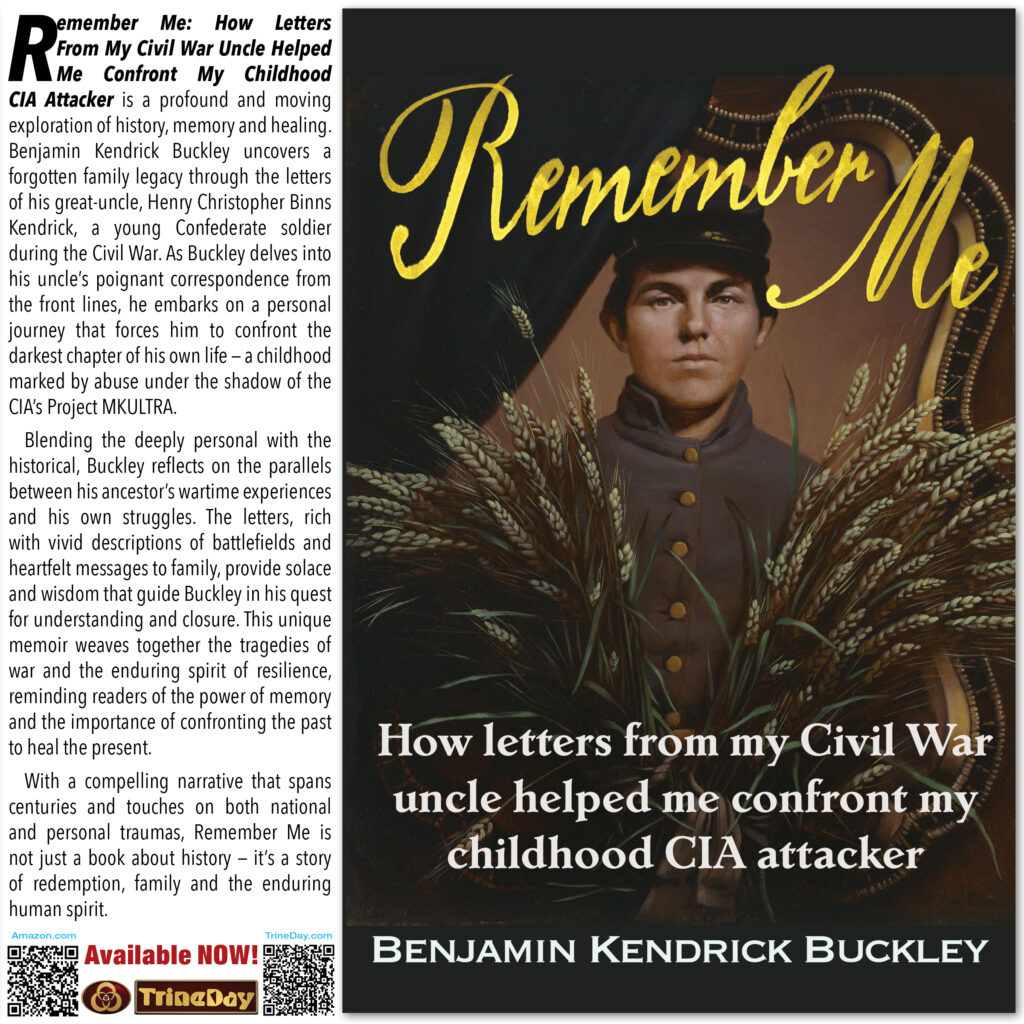
Buckley, a Washington, D.C.–area native and construction professional who worked on sensitive government sites, is the direct descendant of Confederate soldier Henry Christopher Binns Kendrick, who died at the Battle of Gettysburg. Long fascinated by Civil War history, Buckley also carried something far more personal: the psychological scars of childhood abuse that intersected with the early-era experimentation and culture surrounding programs like MKUltra, as the CIA was finding its sea legs.
Civil CIA Not a Thing
After retiring, Buckley uncovered 52 letters his great-uncle had written home during the Civil War. There were no replies—only one side of a deeply human exchange preserved across time. Buckley did something extraordinary: he wrote back.
Answering those letters became more than a historical exercise—it became a lifeline. Across 164 years, Buckley found a striking emotional and philosophical kinship with a man facing the uncertainty of war. In responding, he began to process his own battles: the moral ambiguity of intelligence-adjacent environments he encountered in his youth, and the trauma inflicted by a perpetrator tied to that world.
Through this written dialogue, Buckley confronted what had long remained buried. The act of replying gave him the clarity and courage to face—not just symbolically, but directly—the individual connected to his childhood abuse. What began as an exploration of ancestry evolved into a deeply personal reckoning.
Buckley’s story explores how trauma echoes across generations, how war—whether fought on a battlefield or within institutions—leaves lasting imprints, and how confronting the past can lead to unexpected healing. It also raises broader questions about the unseen human cost of early intelligence programs and the environments they fostered.
This is not just a Civil War story—it’s a story of survival, confrontation, and resolution. Ben Buckley is available to discuss how a stack of 19th-century letters helped him face a 20th-century darkness—and finally reclaim his own narrative.
Relevant Article(s):
OPTIONAL Q&A:
- How did discovering your great-uncle’s 52 letters reshape your understanding of your own life?
- What compelled you not just to read those letters—but to write back across 164 years?
- In what ways did your great-uncle’s Civil War experience mirror your own internal battles?
- How did your early exposure to intelligence environments intersect with the abuse you endured?
- What role did the shadow of MKUltra-era thinking play in shaping those experiences?
- Can you describe the moment you decided to confront the perpetrator of your childhood abuse?
- How did this process of “correspondence” help you reach a place of personal resolution?
- What do you hope others—especially those carrying unseen trauma—take away from your story?
ABOUT BENJAMIN BUCKLEY…
Born and raised in the Washington, D.C. area, Buckley is a descendent of a Civil War Confederate soldier, Henry Christopher Binns Kendrick, who died at the Battle of Gettysburg. Buckley’s career in the construction industry would take him to many government sites where he encountered how the U.S. was attempting to achieve various national security objectives.
Upon retirement, he discovered 52 Civil War letters written by his great-uncle. In reading them, Buckley discovered a striking emotional and philosophical kinship across 164 years. The letters became a critical aide to help Buckley review the darkest chapters in his own life, how he viewed war and abuse, as well as the shadow cast in his life by U.S. intelligence projects such as the CIA’s MK Ultra.
Buckley’s Book is Entitled, Remember Me: How Letters from My Civil War Uncle Helped Me Confront my Childhood CIA AttackerTO SCHEDULE AN INTERVIEW, CALL OR TEXT 512-966-0983 OR EMAIL BOOKINGS@SPECIALGUESTS.COM