
Foster the People: Sitting U.S. Supreme Court Justice’s Role in Cover Up White House Official’s Murder
The death of White House Deputy Counsel Vince Foster was ruled a suicide. Supreme Court Justice Brett Kavanaugh was the lead investigator at the time. A key eyewitness account that grossly contradicts the official narrative remains largely ignored by the American media. Attorney John C. Clarke, who represented witness Patrick Knowlton, is available to discuss evidence suggesting the investigation into Foster’s death was shaped by pressure on a witness whose testimony undermined the government’s conclusion.
- Brett Kavanaugh helped write the Kenneth Starr report declaring Vince Foster’s death a suicide—despite contradictory witness evidence—and now Kavanaugh sits on the U.S. Supreme Court.
- Witness Patrick Knowlton was at Fort Marcy Park at 4:30 p.m. but saw no sign of Foster’s car, contradicting the official timeline.
- FBI agents repeatedly tried to pressure Knowlton to say the car he saw could have been Foster’s. He refused.
- Documents obtained by Ambrose Evans-Pritchard show FBI reports included statements Knowlton says he never made.
- After being subpoenaed, Knowlton reported coordinated surveillance and intimidation in Washington, D.C. aimed at discrediting him.
On July 20, 1993, Knowlton stopped at Fort Marcy Park in Virginia at approximately 4:30 p.m. while driving home from a construction job in suburban Maryland. When he entered the parking lot, he observed only two vehicles: his own and an older brown car with Arkansas license plates. He also encountered a man sitting in another vehicle who lowered his window and stared at him in a way Knowlton found unsettling. Knowlton briefly walked into the park and then returned to his car, leaving shortly afterward.
Listen to recording of an uncomfortable Brett Kavanaugh talking about Foster’s car:
Brett Kavanaugh and Vince Foster
What he did not see was Foster’s silver Honda—despite the official finding that Foster had already died there by suicide earlier that afternoon. Forensic evidence indicated Foster was likely already dead by the time Knowlton arrived. Yet the absence of Foster’s car from the parking lot at that time raises serious questions about the timeline and location of the death.
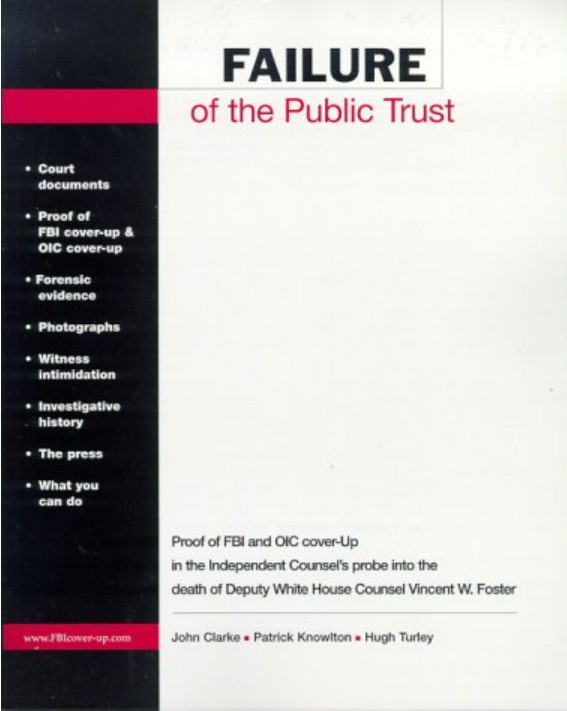
CLICK HERE TO ORDER FAILURE OF THE PUBLIC TRUST
Nine months later, when FBI agents finally interviewed Knowlton, they repeatedly pressed him to say that the car he saw might have been Foster’s silver Honda. Knowlton refused to change his account, maintaining that the vehicle he observed was an older brown car that looked nothing like Foster’s. Documents later obtained by journalist Ambrose Evans-Pritchard showed that the FBI’s typed interview report included statements Knowlton says he never made.
Soon after his account appeared in the Sunday Telegraph, Knowlton was subpoenaed to testify before the Whitewater grand jury overseen by Independent Counsel Kenneth Starr. In the days following the subpoena, Knowlton reported a series of unusual encounters in Washington, D.C., in which multiple men appeared to follow or stare at him in a pattern experts later described as a form of witness intimidation designed to unsettle and discredit a source.
Clarke argues that Knowlton’s testimony exposed deeper problems inside the investigation itself. One of the lawyers working under Starr during the probe was Brett Kavanaugh, who helped draft sections of the final report concluding Foster died by suicide. Today, Kavanaugh sits on the U.S. Supreme Court.
Clarke contends that the underlying investigative record contradicts key conclusions of the official report and that Knowlton’s account remains central to understanding what happened at Fort Marcy Park. As Clarke argues, the case is ultimately about whether government investigators—and the institutions meant to hold them accountable—followed the evidence wherever it led.
RELEVANT ARTICLE(S):
The Vince Foster Cover-up: The FBI and The Press
OPTIONAL Q&A
- How did Brett Kavanaugh help shape the conclusions of the Kenneth Starr report on Vince Foster’s death, and what evidence suggests key facts were ignored?
- Why did eyewitness Patrick Knowlton not see Foster’s car at Fort Marcy Park at 4:30 p.m., despite the official claim that Foster died there earlier that afternoon?
- What happened during the FBI interview when agents repeatedly pressured Knowlton to say the vehicle he saw might have been Foster’s?
- How did documents later obtained by Ambrose Evans-Pritchard reveal discrepancies between Knowlton’s actual statements and the FBI’s written reports?
- Why was Knowlton not called by investigators earlier if his timeline directly challenged the official narrative?
- What happened to Knowlton after he was subpoenaed to testify before the Whitewater grand jury led by Starr?
- What evidence suggests the Foster death scene may have been staged or misrepresented?
- What does the Foster case reveal about the reliability of federal investigations when the same agencies appear across multiple inquiries?
ABOUT JOHN H. CLARKE…
John H. Clarke is a seasoned attorney and member of the District of Columbia Superior Court Fiduciary Panel, specializing in complex litigation, federal oversight, and civil rights matters. Over his career, Clarke has pursued numerous high-profile Freedom of Information Act (FOIA) lawsuits, including cases related to unrepatriated American POWs from the Korean and Vietnam Wars. Notably, in Hall et al. v. CIA, a 21-year litigation effort, he challenged the agency’s failure to search operational records for POWs held in Laos, resulting in a landmark appellate ruling in April 2025.
Clarke has also litigated significant national security and transparency matters, including FOIA actions concerning the Benghazi attack, TWA Flight 800, and Department of Defense record disclosures. He has pursued civil rights claims on behalf of plaintiffs in cases against FBI and federal agents and has successfully compelled disclosure in matters historically shielded by classification.
In addition to FOIA and civil rights litigation, Clarke has investigated high-profile political and governmental controversies, including the death of Deputy White House Counsel Vincent Foster. His work consistently emphasizes accountability, government transparency, and the public’s right to know. Clarke combines legal expertise with rigorous investigative analysis, making him a trusted advocate in cases at the intersection of law, history, and public interest.
Websites: www.VinceFosterMurder.com and www.JohnHClarkeLaw.com

Murder, Murder, Murder, Murder, Murder, Murder, Murder, Murder

