
Former Political Prisoner in Iran talks about Removal of a Tyrant in her Country
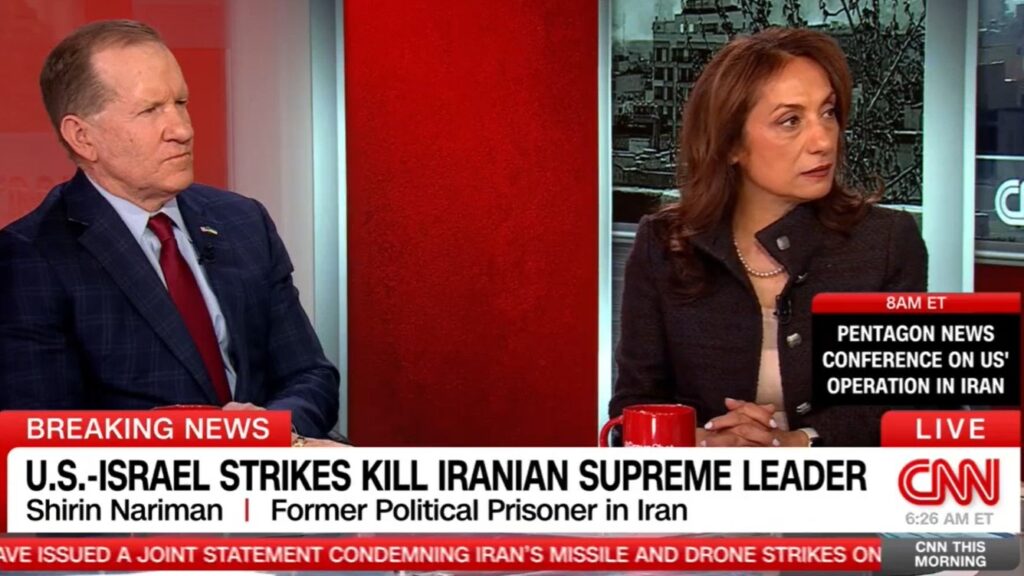
In a recent CNN interview, Iranian dissident and former political prisoner Shirin Nariman offered a deeply personal and historically grounded reaction to the death of Ayatollah Ali Khamenei, the supreme leader of Iran, in an unprecedented U.S.–Israeli strike. Nariman, who spent years imprisoned by the clerical regime for her political activism, spoke not only from the vantage point of a survivor of Iran’s notorious prison system, but from someone who has long called for systemic change in her homeland.
Nariman’s initial response to the news was one of cautious relief. She acknowledged the brutality of Khamenei’s rule, highlighting decades of executions, repression of dissent, and use of the state’s security apparatus to crush basic freedoms. Her own imprisonment, like that of countless others, was a testament to the regime’s willingness to punish political opposition mercilessly. But for Nariman, the death of the Ayatollah was not an endpoint, it was a turning point—an inflection point in Iran’s long struggle between authoritarianism and democratic aspiration.
CNN Features former Political Prisoner
Throughout the interview, Nariman emphasized that while many Iranians celebrated the removal of a figure widely associated with state violence, the real question now is “what comes next.” Drawing on her experience inside Iran and her understanding of the movements pushing for change, she warned that the clerical establishment’s death does not automatically translate into liberation. Instead, she outlined a moment of profound uncertainty: a power vacuum that could be filled by remnant hardliners, a new generation of theocratic rulers, or the long-suppressed democratic movement that has been organizing for decades.
Nariman pressed this point repeatedly. She acknowledged that outside analysts and lawmakers have debated the merits and risks of strikes against Iran’s leadership, but she underscored that Iranians themselves must be at the center of any transition. She cited recent uprisings, generational shifts in attitude toward governance and human rights, and the resilience of opposition groups inside and outside the country as evidence that Iran’s future will be shaped by its people, not foreign powers.
In framing what comes next, Nariman invoked the NCRI’s vision for a post-regime Iran, anchored in democratic principles, secular governance, and human rights. She reiterated her support for Maryam Rajavi’s leadership as president-elect of the NCRI and pointed to the organization’s Ten-Point Plan as a roadmap for replacing theocratic rule with a republic that guarantees freedom of expression, gender equality, separation of religion and state, and peaceful regional relations. From Nariman’s perspective, the moment is not just a geopolitical pivot—it is an opportunity to push toward a people-led future rather than a replay of past authoritarian cycles.
Nariman also candidly discussed the risks ahead. She noted that just as Iranians learned to organize under repression, they must now navigate a period of potential backlash, fragmentation, and violence. Echoing analysts on the broadcast who questioned the stability of Iran’s leadership structures, she warned that remnants of the regime’s security apparatus could attempt to reassert control, or that external pressure could further destabilize society. Nevertheless, she insisted that nothing short of an organized, internally driven movement will prevent another authoritarian force from filling the void.
While recognizing the complexities of regime change—especially in a country long governed by entrenched clerical rule—Nariman used the CNN platform to assert that Iranians have already laid the groundwork for transformation. Their protests, underground resistance networks, and sustained calls for rights reform illustrate a society ready to redefine its identity. For her, the death of the Ayatollah is significant not because it ends an era, but because it signals that the decades-long struggle for a democratic Iran may finally be entering its most consequential chapter.
CNN, CNN, CNN, CNN

