
Cartel Hydras: Cut Off Head, Grow Cartels; Drying up Demand in U.S. is the Answer
Mexico is once again engulfed in bloodshed after the removal of a high-profile cartel leader — a familiar script that Washington and much of the media continue to misread. The official narrative is predictable: take out the head of the snake and the body will die. But as veteran investigative reporter Bill Conroy has documented for decades, the opposite almost always happens.
Bill Conroy’s New Book, The Great Pretense: A Tour Through the Boneyard of the CIA’s War For Drugs
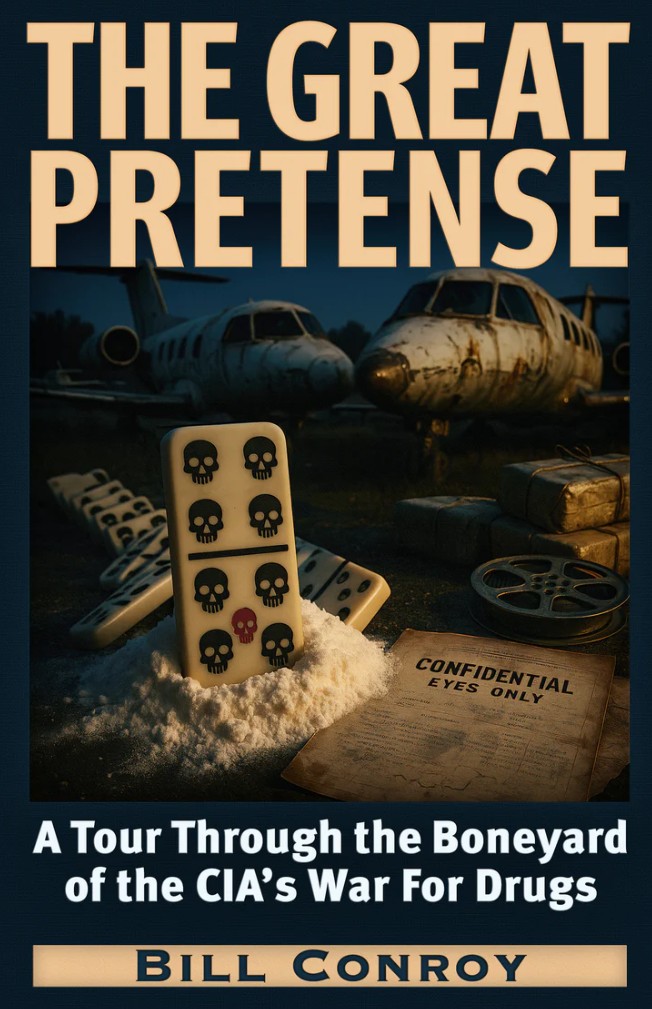
“The kingpin strategy simply doesn’t work,” Conroy says. And Mexico’s current wave of violence proves the point yet again.
Unlike traditional hierarchies, modern drug cartels are not fragile pyramids dependent on a single leader. They are sprawling, decentralized criminal enterprises designed to survive decapitation. When a top figure is removed, the result isn’t collapse — it’s chaos. Lieutenants, regional bosses, and ambitious underlings fight to fill the vacuum, unleashing turf wars that devastate civilians and destabilize entire regions.
Conroy explains that many of these foot soldiers and mid-level operators didn’t begin as hardened criminals. They emerged from what he calls an “economy of poverty,” where desperation replaces opportunity. For people with no viable path out of grinding poverty, cartel life offers something intoxicating: fast money, status, and the promise — however fleeting — of a lavish lifestyle. They trade decades of deprivation for a few years of excess, fully aware the ending is likely violent.
Decapitating leadership only accelerates this cycle. Ambitious underlings, already seasoned by years inside the organization, see opportunity rather than deterrence. The result is fragmentation, not peace — more factions, more weapons, more killings.
Conroy argues that focusing exclusively on Mexico’s cartels ignores the real driver of the violence: demand in the United States. As long as American consumption of narcotics like cocaine continues to surge, the supply chains will regenerate no matter how many leaders are arrested or killed. The drug war’s center of gravity isn’t south of the border — it’s inside broken American communities.
At its root, Conroy says, demand traces back to social decay: broken homes, the erosion of nuclear families, and generations growing up without stability or purpose. That void is increasingly filled with narcotics. Until that demand is confronted honestly, cartel violence will remain a renewable resource.
Mexico’s current crisis isn’t a failure of enforcement — it’s the predictable outcome of a strategy that’s been wrong for decades. And the body count keeps proving it.
SUGGESTED Q&A
- What specifically happens inside cartel structures after a kingpin is removed that leads to immediate spikes in violence?
- Why does the “head of the snake” strategy persist in U.S. policy circles despite decades of evidence it fails?
- How do underlings groom themselves for leadership long before a cartel boss is taken out?
- Can you explain the “economy of poverty” and why it keeps replenishing cartel ranks?
- Why does cartel fragmentation make civilians more vulnerable, not safer?
- How directly does U.S. drug demand — especially cocaine — drive today’s violence in Mexico?
- What role do broken homes and the decline of the nuclear family play in sustaining narcotics demand?
- If decapitation strategies don’t work, what policies would actually reduce cartel power and violence?
Related Article(s)
Killing of Mexican drug cartel boss ‘El Mencho’ triggers wave of violence | Mexico | The Guardian
US citizens urged to shelter in place amid unrest in Puerto Vallarta
ABOUT BILL CONROY…
Bill Conroy, M.A. in Mass Communications/Journalism (Marquette University), is a veteran journalist with 40 years of experience working as a staff reporter, editor-in-chief, and freelance correspondent at print and online publications across the United States and in Mexico. His journalism has been cited in more than 35 books to date. Conroy also is the author of the nonfiction books The Great Pretense: A Tour Through the Boneyard of the CIA’s War for Drugs; Dispatches from the House of Death: A Juarez Cartel informant, a DEA whistleblower, mass murder and a coverup on the edge of the Empire; and Borderline Security: A Chronicle of Reprisal, Cronyism and Corruption in the U.S. Customs Service.
TO SCHEDULE AN INTERVIEW, CALL OR TEXT 512-966-0983 OR EMAIL BOOKINGS@SPECIALGUESTS.COM