
John Solomon sits down with Red Tsunami Author in-studio to Talk about CCP Threat
Via Real America’s Voice (RAV):
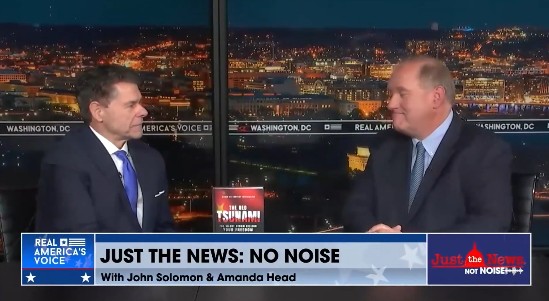
National security expert Casey Fleming joined investigative journalist John Solomon on Just the News at Real America’s Voice for a wide-ranging discussion centered on Fleming’s book, The Red Tsunami, and the evolving strategic threats posed by the Chinese Communist Party (CCP) to the United States.
During the interview, Fleming outlined the core themes of The Red Tsunami, which examines how China has pursued long-term influence and leverage across economic, technological, political, and informational domains. Fleming emphasized that the book is not focused on partisan politics, but rather on national security risks that cut across administrations, industries, and institutions. He framed the challenge from the CCP as a systemic and sustained campaign that operates largely outside the awareness of the general public.
Fleming explained that unlike traditional military threats, the CCP’s strategy relies heavily on non-kinetic methods, including economic dependency, intellectual property acquisition, cyber operations, and influence within corporate and academic environments. He noted that these methods often unfold incrementally, making them harder to detect or counter using conventional defense frameworks. According to Fleming, this slow and deliberate approach has allowed China to gain footholds in critical sectors without triggering immediate alarm.
Real News, No Noise
John Solomon guided the conversation toward how these threats manifest inside the United States. Fleming discussed vulnerabilities within supply chains, technology platforms, and financial systems, arguing that globalization and outsourcing have unintentionally increased exposure to strategic pressure. He stressed that many of these risks are not hypothetical but observable through patterns of dependency that could be exploited during moments of geopolitical tension or crisis.
A key point of the interview focused on awareness and preparedness. Fleming argued that Americans often underestimate the scope of modern strategic competition because it does not resemble past conflicts. Rather than visible confrontation, today’s threats operate through leverage, influence, and access. He emphasized that recognizing these realities is the first step toward building resilience, both at the governmental level and within the private sector.
Fleming also addressed the importance of information integrity, noting that narratives and messaging play a significant role in shaping public perception. He warned that information warfare can be just as impactful as economic or technological pressure, particularly in an era dominated by digital media and rapid dissemination of content. According to Fleming, understanding how narratives are formed and amplified is critical to protecting democratic institutions.
Throughout the interview, Fleming positioned The Red Tsunami as an educational resource designed to inform policymakers, business leaders, and citizens alike. He explained that the book aims to translate complex intelligence and security concepts into accessible language, helping readers understand how global strategy intersects with everyday life. Fleming emphasized that the goal is not fear, but clarity and informed decision-making.
Solomon and Fleming also discussed the broader implications for U.S. leadership on the world stage. Fleming suggested that strategic competition with China requires long-term thinking, coordination across sectors, and a clear-eyed assessment of national priorities. He noted that reactive policies are insufficient when confronting a disciplined, decades-long strategy.
The interview concluded with Fleming reiterating the need for vigilance, transparency, and education. He emphasized that addressing these challenges does not rest solely with government agencies, but also with corporations, institutions, and informed citizens who understand the stakes involved. By increasing awareness and encouraging proactive engagement, Fleming argued, the United States can better safeguard its economic stability, national security, and democratic values.
The full interview with Casey Fleming and John Solomon is available on Just the News at Real America’s Voice, providing viewers with an in-depth discussion of The Red Tsunami and the strategic realities shaping the current global landscape.

News, News, News, News

