
Catholic Swamp: Elite Protestants Convert in Washington while the Church Loses Members Nationwide at Higher Rate
The Vatican is having to confront an interesting dilemma. While nationwide data show Catholicism hemorrhaging members to Protestant denominations at a staggering 8‑to‑1 ratio, recent reporting highlights an intriguing anomaly: in elite circles, particularly in Washington, D.C., a small but visible number of Protestants are converting to Catholicism. These converts are often young, highly educated, and strategically positioned within professional and political networks. Their decisions are influenced not merely by theology but by the prestige, social connections, and institutional influence that Catholicism retains in these power hubs.
Order Vatican Coup: Blackmail and Espionage in the Catholic Church
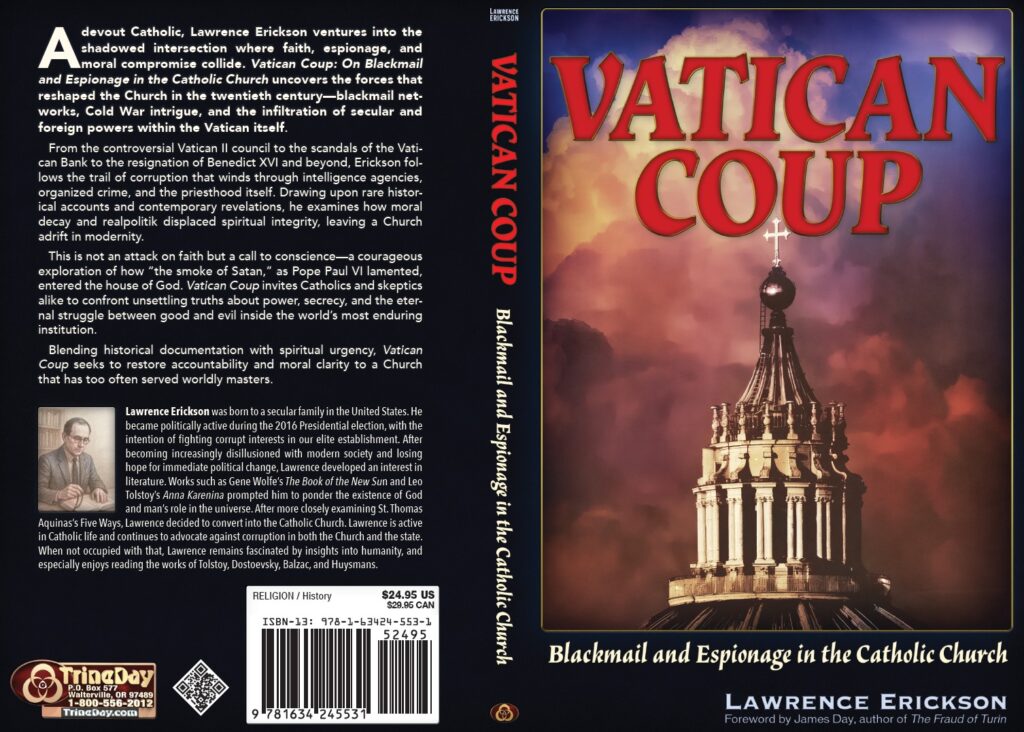
Lawrence Erickson, author of Vatican Coup: Blackmail and Espionage in the Catholic Church, has discovered significant corruption in the Catholic Church. In particular, that corruption is among the elites. Many of those elites are seeking followers in global power centers. Washington, D.C. is certainly such a place.
Vatican Move toward Elites about Power, Money, and Influence
For Erickson, whose work in Vatican Coup exposes entrenched corruption, bureaucratic maneuvering, and institutional self-interest within the Vatican, these trends provide fertile ground for analysis. The stark contrast between the massive exodus of ordinary Catholics and the selective influx of elite converts underscores the duality of the Church’s public image: while it claims moral and spiritual authority, its internal operations continue to prioritize influence, control, and image management.
The trend of elite Protestant conversions suggests a Church leveraging its institutional power to attract strategic adherents rather than cultivating authentic grassroots growth. Erickson’s reporting on financial malfeasance, political intrigue, and hierarchical secrecy in Rome provides a lens for understanding these conversions. They are not occurring in a vacuum; rather, they reflect a Church whose appeal in the corridors of power often outweighs its moral or theological credibility. This reinforces Erickson’s thesis that Vatican leadership has long been preoccupied with consolidating authority and projecting influence, sometimes at the expense of spiritual transparency.
By highlighting these patterns, Erickson can frame a broader narrative: the Catholic Church’s survival in elite spheres is less a sign of spiritual renewal and more evidence of calculated institutional strategy. The conversions in Washington, D.C., and similar circles serve as microcosms of a Church that thrives on symbolism, strategic alignment, and social capital, even as the general population increasingly turns away.
Lawrence Erickson’s insights are uniquely positioned to contextualize this anomaly. He can explain why elite Protestant conversions are both a symptom of and a window into the Vatican’s enduring corruption, revealing how power, prestige, and political influence continue to shape the Church’s appeal in selective spheres. This perspective makes clear that understanding Catholic growth—or loss—requires examining not just national trends but the underlying motives and structural dynamics within Rome itself.
Vatican Coup: On Blackmail and Espionage in the Catholic Church – TrineDay
Relevant Article(s):
Rome’s lure for young Protestant belivers | WORLD
OPTIONAL Q&A:
- How do elite Protestant conversions to Catholicism in Washington, D.C., reflect the Vatican’s influence strategies?
- Why does Catholicism continue to attract strategic converts despite losing members nationally at an 8‑to‑1 rate?
- How do these conversions underscore the patterns of corruption and power Erickson documents in Vatican Coup?
- Are these elite conversions motivated more by prestige and institutional influence than genuine faith?
- What does the contrast between national Catholic decline and elite growth say about the Church’s priorities?
- How has Vatican leadership historically leveraged social and political capital to maintain authority?
- Do these conversion patterns reveal systemic weaknesses in the Church’s moral and spiritual authority?
- What lessons can Americans draw about the Church’s internal operations from these elite conversion trends?
ABOUT LAWRENCE ERICKSON…
A devout Catholic, Lawrence Erickson ventures into the shadowed intersection where faith, espionage, and moral compromise collide.
Vatican Coup: On Blackmail and Espionage in the Catholic Church
uncovers the forces that reshaped the Church in the twentieth century—blackmail networks, Cold War intrigue, and the infiltration of secular and foreign powers within the Vatican itself.
From the scandals of the Vatican Bank to the resignation of Benedict XVI, Erickson follows the trail of corruption that winds through intelligence agencies, organized crime, and the priesthood itself. Drawing upon rare historical accounts and contemporary revelations, he examines how moral decay and realpolitik displaced spiritual integrity, leaving a Church adrift in modernity.
This is not an attack on faith but a call to conscience—a courageous exploration of how “the smoke of Satan,” as Pope Paul VI lamented, entered the house of God.
Vatican Coup invites Catholics and skeptics alike to confront unsettling truths about power, secrecy, and the eternal struggle between good and evil inside the world’s most enduring institution.
TO BOOK THIS GUEST, CALL OR TEXT 512-966-0983 OR EMAIL BOOKINGS@SPECIALGUESTS.COM