
‘We’ Run Iran: Numbers Overwhelm Mullahs as Uprisings Reach Tipping Point
The world is witnessing a mass uprising in Iran; it’s reaching critical mass. The sheer numbers are reaching those of one of the most decisive moments of the modern Middle East: the day 30 million Egyptians took to the streets in 2013 and swept away the Muslim Brotherhood. History shows that when numbers reach such a lopsided dynamic, tyrants do not negotiate — they collapse. There is often nothing more powerful than simple math.
Alireza Jafarzadeh, Deputy Director of NCRI, Shahin Gobadi, member of NCRI Parliament in Exile, and NCRI’s Ali Safavi are available for interviews to layout the reality that explains the regime’s increasing desperation. Mrs. Maryam Rajavi is the NCRI’s candidate for President.
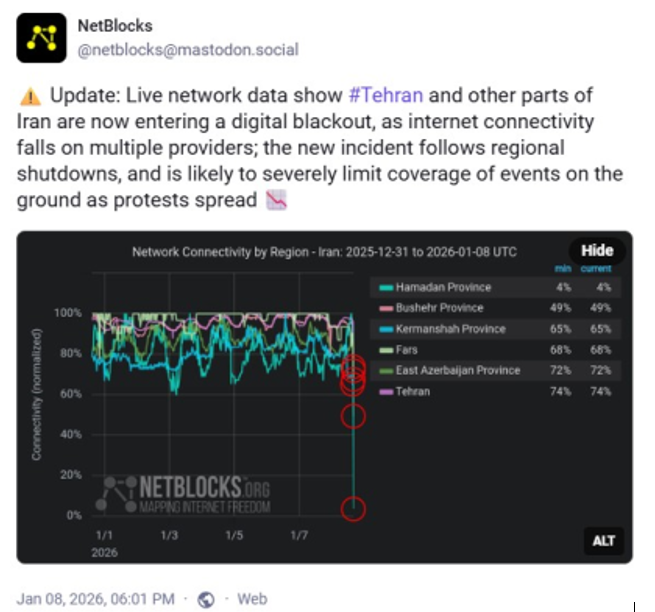
The mullahs have imposed a sweeping digital blackout, attempting to sever communication between citizens and to block outside voices of solidarity. But this is not strength — it is panic. By cutting off the internet, the regime has inadvertently stripped away its own narrative defenses. The confrontation is no longer muddied by propaganda or intermediaries; it is increasingly reduced to a stark showdown between the ruling clerics and the people themselves.
Rather than intimidating the population, the blackout may prove counterproductive. It reinforces what what the people already know: the regime fears unity more than anything. When people cannot speak digitally, they gather physically. When lies are harder to spread, truth spreads faster in the streets. The regime’s actions are narrowing the battlefield — and that battlefield favors the people.
In a further sign of delusion, Tehran is now claiming the protests are driven by a desire to “please Trump.” This is not analysis — it is manufactured denial, a symptom of a regime that cannot face reality. The people are not risking their lives, livelihoods, and families for any foreign leader. They are rising because they are exhausted by tyranny, repression, persecution, corruption, and executions. These grievances predate any U.S. administration and will outlast the regime itself.
The NCRI can speak clearly to this moment: a tipping point is approaching. A desperate regime is taking drastic measures, but no amount of censorship or scapegoating can defeat numbers. When millions move together, history only moves one way — forward.
Speakers Available:
Alireza Jafarzadeh – Deputy Director of NCRI
Shahin Gobadi – Member of NCRI Parliament in Exile
Ali Safavi – Member of NCRI Parliament in Exile
Other Speakers Available:
Shirin Nariman – Former Political Prisoner
Dr. Ramesh Sepehrrad
Dr. Kazem Kazerounian
Related Article(s)
Iran signals protest crackdown coming | AP News
Optional Q&A
- Why does the NCRI believe approaching a mass-uprising tipping point?
- How do growing protest numbers fundamentally change the regime’s ability to survive?
- Why is the regime imposing digital blackouts now, and what does that signal?
- How could cutting internet access actually strengthen street-level resistance?
- What parallels does the NCRI see between the country today and other regimes that collapsed under mass protests?
- Why is the regime blaming foreign leaders instead of addressing public grievances?
- How do executions and repression accelerate rather than suppress popular uprisings?
- What message does the NCRI have for the people as the confrontation narrows to people versus mullahs?
Nationwide Uprising- No. 32
Iran: Nationwide Internet Shutdown Ordered by Khamenei as Uprising Expands
• Calls for Urgent International Action to Ensure Free Internet Access for the People of Iran
Fearing the escalation of the nationwide uprising, the clerical regime has imposed a ‘digital blackout,’ completely shutting down the internet across Iran since Thursday, January 8. This action, on the twelfth day of the uprising, follows its expansion on Tuesday and Wednesday, January 6 and 7. The shutdown is intended to prevent the dissemination of images of heroic acts by rebellious youths and news of the suppressive forces’ crimes. The regime had already been throttling internet speeds in the days prior.
This morning, January 8, the internet observatory NetBlocks officially confirmed the shutdown. By publishing a network status chart, it reported that ‘Tehran and other parts of Iran are now entering a digital blackout,’ with internet access plummeting to just 5%.
Technical data from Cloudflare Radar shows that just before 13:00 local time, Iran’s IPv6 addressing space experienced a 98.5% drop, with the protocol’s traffic declining from 12% to 1.8%.
The Iranian Resistance considers this internet shutdown a clear violation of the fundamental rights of the Iranian people, as it blatantly contravenes Article 19 of the Universal Declaration of Human Rights and UN Human Rights Council resolutions, including resolution 47/16, which strongly condemns such shutdowns. The Iranian Resistance calls on the United Nations, its member states, the Human Rights Council, and the International Telecommunication Union (ITU) to strongly condemn this ‘cyber siege’ and take immediate measures to ensure the Iranian people’s free access to the internet.
Secretariat of the National Council of Resistance of Iran (NCRI)
January 9, 2026
ABOUT ALIREZA JAFARZADEH…
Alireza Jafarzadeh serves as the Deputy Director of the Washington Office of the National Council of Resistance of Iran (NCRI). He is also the author of The Iran Threat (Palgrave MacMillan, New York, 2008).
A recognized expert on Iranian policy, Jafarzadeh has been at the forefront of efforts to prevent the Iranian regime from acquiring nuclear weapons. His groundbreaking work in 2002 and 2003 led to the discovery of key illicit nuclear sites in Iran, including the Natanz uranium enrichment facility, the Arak heavy water plant, the Kalaye Electric centrifuge testing facility near Tehran, and the Lashkar Ab’ad laser enrichment facility. These revelations prompted the first-ever inspections of Iranian nuclear sites by the International Atomic Energy Agency (IAEA).
Jafarzadeh is a frequent guest on major television and radio networks, including CBS Evening News, CNN, MSNBC, Fox News, CNBC, Bloomberg TV, and France 24. His insights have also been featured in leading publications such as The New York Times, The Washington Post, The Wall Street Journal, Los Angeles Times, USA Today, Time, and The Hill.
ABOUT SHAHIN GOBADI…
Shahin Gobadi, a U.S.-educated nuclear engineer, is a member of the National Council of Resistance of Iran (NCRI), Iran’s Parliament-in-Exile.
An astute observer of Iranian affairs for over three decades, Gobadi is an expert on topics including Iranian state-sponsored terrorism, proxy groups in the Middle East, the Iranian nuclear and weapons of mass destruction (WMD) programs, Western policy toward Iran, and internal Iranian affairs.
He has been interviewed by major international media outlets, including CNN, Fox News, BBC, Sky TV, GB News, The New York Times, The Wall Street Journal, The Washington Post, The Times, The Daily Telegraph, Reuters, and the Associated Press. Gobadi’s writings have appeared in prominent media across the U.S. and Europe.
ABOUT ALI SAFAVI…
Ali Safavi is a member of the National Council of Resistance of Iran (NCRI), Iran’s Parliament-in-Exile.
A sociologist by training, Safavi studied and taught at UCLA, California State University Los Angeles, and the University of Michigan. He was an active participant in the anti-Shah student movement in the 1970s in the United States and has been deeply engaged in Iranian affairs ever since.
Safavi has lectured and written extensively on nuclear proliferation, and Middle Eastern politics. He has appeared in interviews on networks such as CNN, Fox News, MSNBC, CBS, BBC, Sky TV, Newsmax, and France 24. His articles and commentary have been published in leading outlets, including The New York Times, The Wall Street Journal, The Hill, The Boston Herald, The Washington Times, and The Financial Times.
This material is distributed by Special Guests Publicity LLC on behalf of National Council of Resistance of Iran (NCRI) / Media Strategy Consulting LTD. Additional information is available at the Department of Justice, Washington, DC. CONTACT: For further details or to arrange the interview, please contact Jerry McGlothlin at 919-437-0001 / Bookings@SpecialGuests.com