
Cage Charmer: Why Mangione Charisma and Anti-establishment anger Equate to Unlikely Prison Following
Dr. John Brady is uniquely positioned to dissect one of the most unsettling—and strangely captivating—criminal sagas in recent memory: the Luigi Mangione phenomenon. Mangione’s case has now crossed beyond true-crime curiosity and into cultural flashpoint, tapping directly into the country’s simmering distrust of elites and its growing sympathy for “ordinary people pushed too far.” What makes Mangione unusual isn’t only the allegation of murder—it’s the reaction to it.
Inside the jail, Mangione has become an anomaly. Guards describe him as polite, rational, even thoughtful. Fellow inmates—many hardened, many cynical—aren’t just respectful of him; some openly agree with the convictions that drove his worldview, even while rejecting the violence he’s accused of. They see in Mangione not a monster, but a man who articulated grievances they’ve lived with for years. This is rare territory in forensic psychology: a suspect whose moral framework resonates more broadly than the act he may have committed.
That strange blend of relatability, rebellion, and alleged brutality is creating a dynamic unlike anything in the modern criminal landscape. Mangione has, intentionally or not, become a mirror reflecting the national divide between elites and the rest of America—the resentment, the distrust, the belief that institutions have failed. His story is tapping into something raw.
And this is where Dr. Brady stands apart.
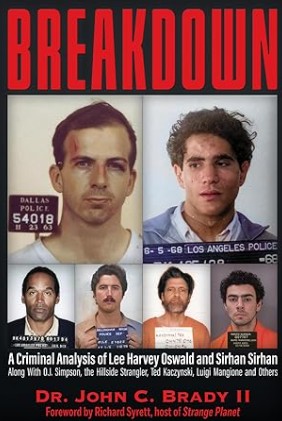
A forensic psychologist who has spent decades inside the minds of murderers, manipulators, and extremists, Brady understands how individuals like Mangione can slip into moral absolutism while maintaining a disarmingly likable persona. His latest book, Breakdown, devotes an entire section to the Mangione case, analyzing how a seemingly ordinary man can become a lightning rod for cultural angst.
Brady can explain why Mangione’s demeanor disarms people, why inmates and guards find themselves nodding along with his worldview, and why this case reveals far more about society than about one alleged killer.
No one can frame the psychological stakes—and the cultural implications—of the Mangione phenomenon better than Dr. John Brady. This is not just a criminal case. It is a national Rorschach test, and Brady is the expert who can interpret it.
Psychological DNA: A Cold Case Analysis of Who Killed Robert F. Kennedy
Pre-Order Brady’s new Book Breakdown: A Criminal Analysis of Lee Harvey Oswald and Sirhan Siran
Relevant Article(s):
Luigi Mangione’s defense team fights to exclude evidence ahead of murder trial | Fox News Video
Pre-Order Dr. Brady’s New Book
OPTIONAL Q&A
- What drives an inmate like Mangione to earn respect from both guards and prisoners?
- How does likability complicate traditional assessments of dangerousness?
- Why do some offenders become symbols of “people vs. elites,” even inside prison walls?
- What psychological profile fits someone who inspires support despite an alleged murder?
- How do shared grievances inside prisons fuel the Mangione phenomenon?
- What makes Mangione’s case different from other charismatic offenders you’ve studied?
- How does your book Breakdown explain the public’s fascination with morally conflicted criminals?
- What should the public understand about the psychology behind Mangione’s unexpected influence?
ABOUT DR. JOHN BRADY…
Dr. John Brady is a forensic psychologist who for 25 years has spent hours analyzing why individuals commit heinous crimes, providing testimony in numerous criminal cases, and writing six books taken directly from his professional clinical work and court records.
Having worked with some of the nation’s top defense attorneys, prosecutors, private investigators, judges and even perpetrators themselves, Dr. Brady holds that powerbrokers in some of the most prosperous communities often work to hide the evil lurking within some of the biggest work hubs, endangering the public by withholding information.
Dr. Brady, who has written about why wealthy women shoplift to why individuals commit horrific mass-murders, can explain the step-by-step journey taken in the perpetrators’ unconscious journey into darkness.
“It is possible to learn to identify the hidden reasons for crime,” said Dr. Brady, “to understand what leads an individual to the breaking point.”
Whether such behaviors can be attributed to depression, to over-medication with anti-psychotic drugs, or to disorders such as dissociative identity disorder, Dr. Brady can discuss why the criminal is often caught in their own trap.
Books by Dr. Brady include:
PSYCHOLOGICAL DNA: A Cold Case Analysis of Who Killed Robert F. Kennedy
Men of steal: A brief look at the psychology of Celebrity Theft
Why Rich Women Shoplift
Klepto-Bismo: Big Pharma, Shoplifting and Psychiatric Deception
Caught in a Trap
Treat Me: Help for Behavioral Addictions
To schedule an interview, contact Bookings@Specialguests.com or call / text 512-966-0983